
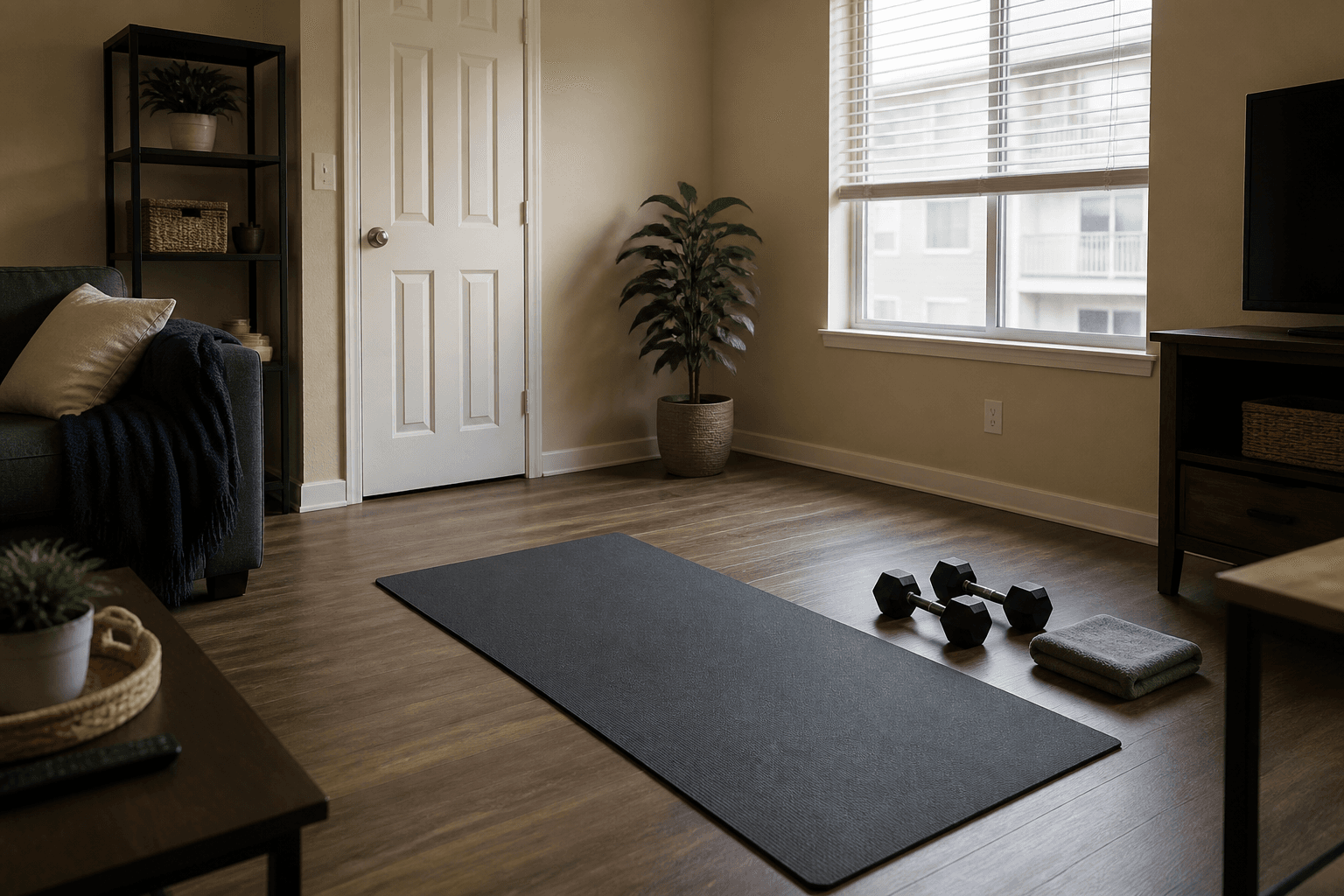
Feng Shui home gym layout is the practice of giving sweat a living-room or hallway corner, then putting mats and weights away so the room can sit or walk again. You keep the gear off the mattress and off the foot of the bed. It is furniture work. It is not a training plan.
When we photograph apartments billed as a "fitness corner," the corner is usually the bed. A mat lives at the footboard. Dumbbells flank the nightstands. Someone asks which compass wall "activates fire." We ask them to lie down. If the first objects in the pillow view are iron and rubber, the room is still performing. This guide is that check, then the put-away.
What is a Feng Shui home gym?
It is a defined sweat zone that can disappear. The job is fire in the Five Elements sense: heat and motion in a room that is on. Sleep is the opposite job. Mixing them on the same floor plate is how a bedroom becomes a second gym and a gym becomes a second bedroom.
Form School cares about use. A living room that hosts a short session and then returns the sofa to sitting is finished. A mattress with a rack in its sightline is not.
This is narrower than a whole-home health layout. That page wants air, a bed that can see the door, and a leak you actually fix. It will not prescribe a squat rack. It will not treat disease. Moving a kettlebell is not a protocol.
Chi talk on home gyms usually means leftover objects. Gear that stays out is visual noise, the same problem the anxiety layout page names as piles you still have to look at. A bin with a lid is quieter than a row of bells on the duvet line. Neither page is a treatment.
A bagua overlay is optional. South is the fire sector on many maps, which is a living-room wall more often than a headboard. Do not drag a rack into the bedroom because an app labeled the east wall "health." Health-as-map is a label. The mattress still needs to be a mattress. Buying red dumbbells and leaving them aimed at the pillow is not a fix. Color is taste. Placement is the work.
Why keep fire and sweat off the bed?
Lie on your back. Look toward the foot. If you can count plates, a jump rope, or a foam roller, the sleep room is still a gym.
Photos keep showing the same miss. The listing had a "flex room." The flex is a full bed plus a mat that never gets rolled. You sit up at 2 a.m. and kick a bell. You walk the dark path and the mat is a trip. None of that needs a lecture about energy. It is enough reason to move the object.
Classical rest-and-active pairing is ordinary: sleep rooms stay dim and spare, sweat rooms can be loud and hot for a while. The bedroom layout rules you already know still apply. Solid wall behind the head, a view of the door without lying in the doorway, a path you can walk without kicking laundry. A rack at the footboard breaks the path and the view.
If you share the bed, do the lie-down test together. One person likes to stretch on the rug before sleep. The other sees equipment and cannot drop their shoulders. The person who startles is the one the layout has to serve.
A mirror at the foot of the bed for "checking form" stacks two problems. Glass that shows the mattress is already a sleep miss. Adding iron in the same view does not cancel it. Dress and train somewhere the duvet is not the backdrop.
The foot-of-the-bed test
Do this at the hour you actually sleep, not in a made-bed listing photo.
- Lie where you sleep.
- Name every piece of gym gear you can see without sitting up.
- Sit up the way you do in the night. If a bell or a mat is the first object, mark it.
- Walk from the bedroom door to the bed. If you step on rubber or around iron, mark that too.
You do not need a compass for this. You need a yes or no. Write which objects failed. The next sections only move those objects.
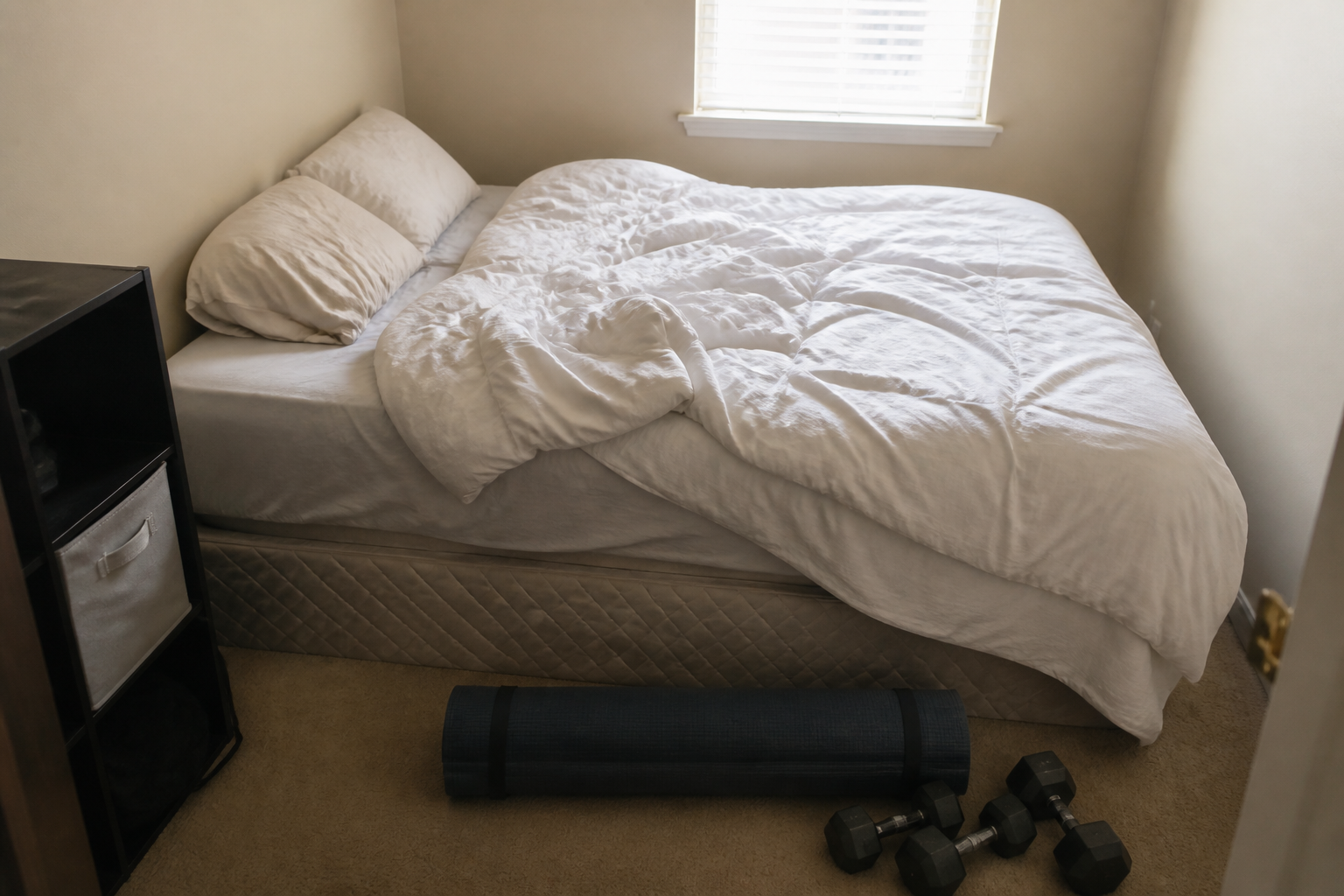
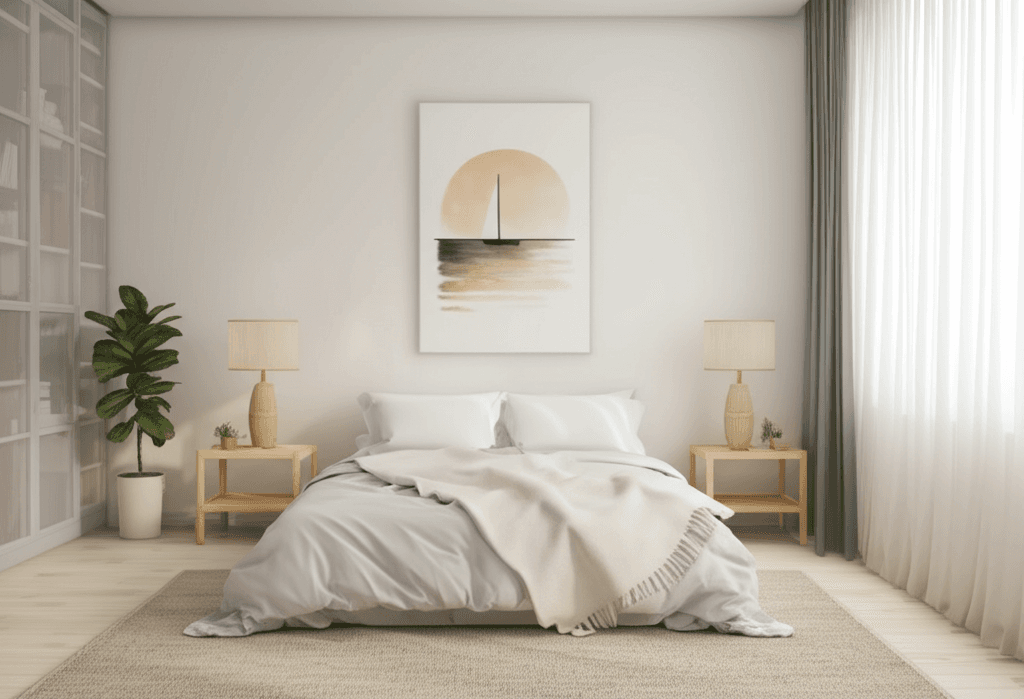
That photo is the usual rental failure. The mat is the rug. The bells are nightstand sculpture. From the pillow the room is still a gym, even if nobody is sweating.
Where should a home gym go in a rental?
Default to the living room, against a wall that is not the TV handshake and not the sofa's back. You want a strip of floor you can claim for a session and then give back. A hallway that is already a dead end can work if the door still opens and nobody has to climb the mat to reach a coat.
A true spare room with no bed is the easiest case. Call it a gym. Keep a clear walk to the door. Put a basket for the small stuff. Do not drag a guest mattress in "for holidays" and then leave the rack at its foot. That is how a gym becomes a second bedroom.
The kitchen is a poor default. Floors get wet. Paths are already tight. A bell beside the stove is a trip. If the only hard floor is kitchen tile, unroll, work, roll, and store in another room.
Face the room entrance if you can, the way a desk faces the door. If the only wall that fits the mat puts your back to the door, it is acceptable for a short session. Do not rearrange the whole apartment around a plank. Do not block an egress with a bench.
Living room versus the only bedroom
Studio rentals have one floor for sleep and sweat. The rule does not change. The bed stays the bed. The gym is a timed use of floor, then storage.
Slide the coffee table if that is the only open rectangle. Put felt pads under it so you can move it twice a week without scraping. When you are done, the table comes back and the mat goes in a closet, under the sofa, or in a basket that is not at the foot of the bed.
Do not store bells under the bed. Under-bed storage is already a sleep-clutter problem in the bedroom guide. Iron under the slats is extra weight you feel when you look at the dust ruffle and remember the gym is still there.
If the sofa is a pull-out you sleep on, treat that sofa as a bed at night. The mat cannot live in front of it until morning. Park gear on a shelf behind the TV stand or in the entry closet.
How do you put the gear away after you sweat?
A rack that stays loaded in a sleep sightline still fails. A cheap basket that closes still passes.
Name a home for each object you actually own. A mat stands in a tall basket or slides under a sofa that is not a bed. Dumbbells sit on a low shelf or in a crate with a lid. Bands go in a pouch so they do not become drawer spaghetti. A jump rope hangs on a removable hook inside a closet, not on the bedroom door.
Open storage only works if you like looking at steel. Many people say they will "get used to it." When we photograph those rooms later, the bells have migrated to the nearest horizontal surface, which is often the dresser. Lids beat good intentions.
Sweat smell is a practical air problem, the same family as the health guide's "open a window" note. Crack a living-room window after a session if the weather and the lease allow it. Wipe the mat. Do not drape a damp towel on the headboard to dry. That turns the sleep wall into a laundry line.
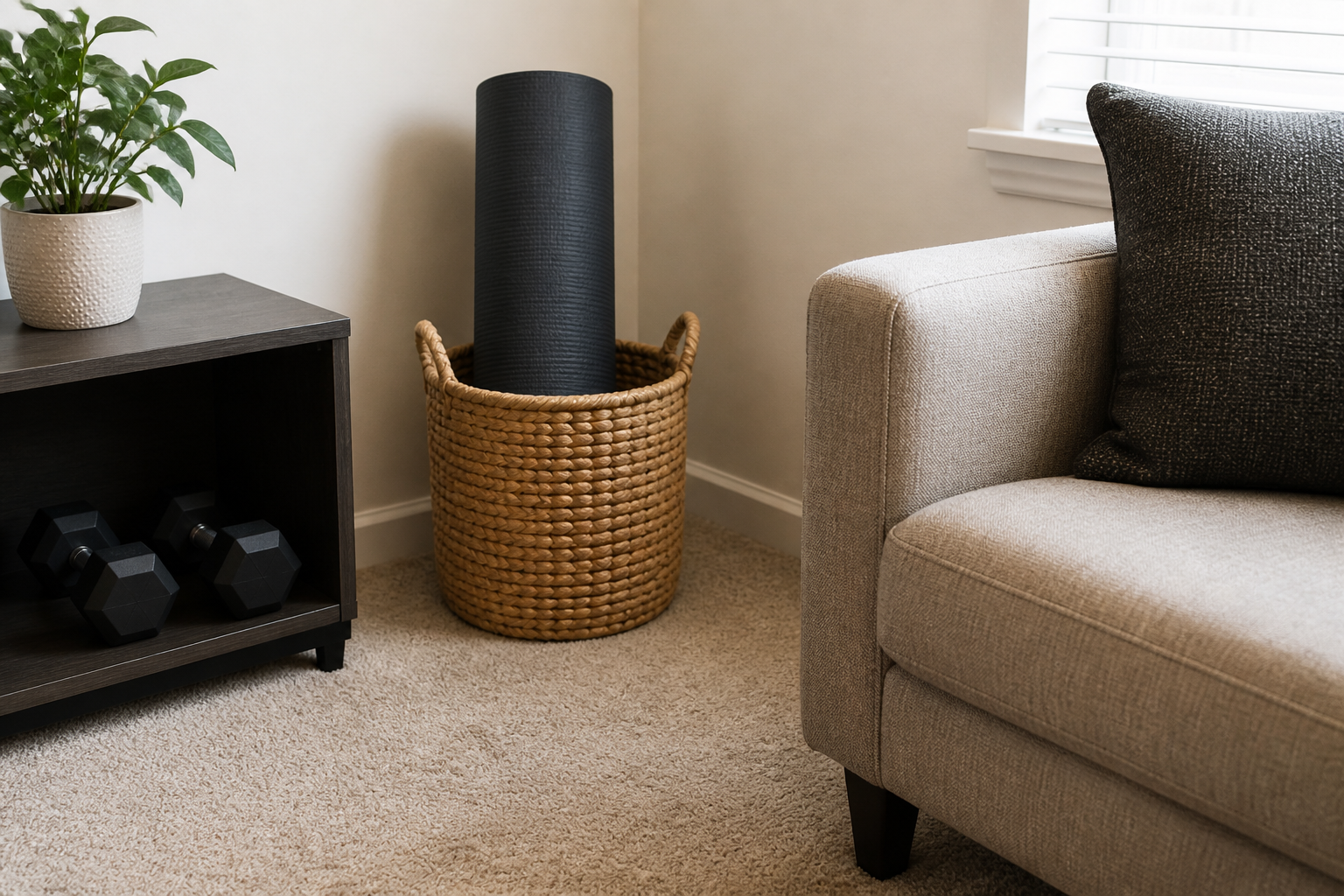
The basket and the low shelf are doing the job. The sofa still sits. The gear is present without owning the foot of a bed. That is the living-room version of fire that can turn off.
What to skip
Skip a cage bolted to rental studs. Skip a treadmill that becomes a clothes rack in the bedroom doorway. Skip crystals on the weight tray and a fountain beside the mat. This page is rubber and iron.
Skip leaving the mat unrolled as a "reminder to move." An unrolled mat is a rug with a story. You will walk around it and then lie in bed looking at it. Roll it.
Can renters set this up without drilling?
Most of the work is sliding and containing. Felt pads. A basket from the closet you already have.
Removable hooks inside a closet door can hold a rope or a band. Read the weight rating. Do not hang a heavy bag from a rental ceiling. Do not screw a pull-up bar into a frame you cannot restore. A doorway bar that uses pressure can bruise paint. If you use one, pad it and take it down between sessions.
Photograph the living room before you add a shelf so you remember the original look for the deposit. A gap beside the sofa can hold a narrow crate. The bathroom is not a gym. If the only storage is the bedroom closet, use it. Closet storage is not the same as foot-of-bed display. Close the door. The pillow should not see the bells.
Does a home gym treat health or anxiety?
No, and that is the same limit as the rest of the wellness hub. The health guide wants air, a bed out of the door line, and a leak fixed as plumbing. It will not tell you that a kettlebell session "is" vitality. If you have symptoms, that is a clinician's job.
The anxiety guide wants a door you can see and a surface that resets. A gym that stays exploded across the floor is extra noise. Putting the gear away can make the living room easier to sit in. Keep therapy and medication if you already use them.
You can sweat and sleep in one apartment. You cannot park the rack in the sleep sightline and call both jobs done. You do not need a scarlet wall to justify a mat. You need a floor and a place the objects go when you are done.
What this is not
A home gym will not make you wealthy or medically well because the bells sat in the south. It will not replace the bedroom geometry in the bedroom guide. Skip slogans about "crushing stagnant chi" as a workout cue. If rest is unwell, use a clinician. If the room is cluttered, use a basket.
Write down what you moved. The next time a listing shows "space for a home gym" in a photo of a queen bed, you will remember that the iron looked tidy in daylight and felt like a loading dock from the pillow.
A simple evening reset
Do this in order. Stop when the pillow view is clear of gym gear and the living room can sit.
- Lie down. Name every piece of equipment you can see.
- Carry those pieces to the living room or closet you chose.
- Roll the mat. Stand it in the basket or slide it under the sofa.
- Wipe the floor if you dropped grit. Put the coffee table back if you moved it.
- Close the bedroom closet if that is where the bells live.
- Photograph from the pillow and from the sofa in FengShui Hero. Compare the flagged wall with what you just cleared.
If you share the apartment, agree on the home for the gear. A "correct" blog corner is useless if one person restacks bells at the footboard because that was the shortest walk after a session.
If you only do one thing, take the gym off the foot of the bed tonight. Unroll it tomorrow in the living room, sweat, and put it away. That is the whole practice.