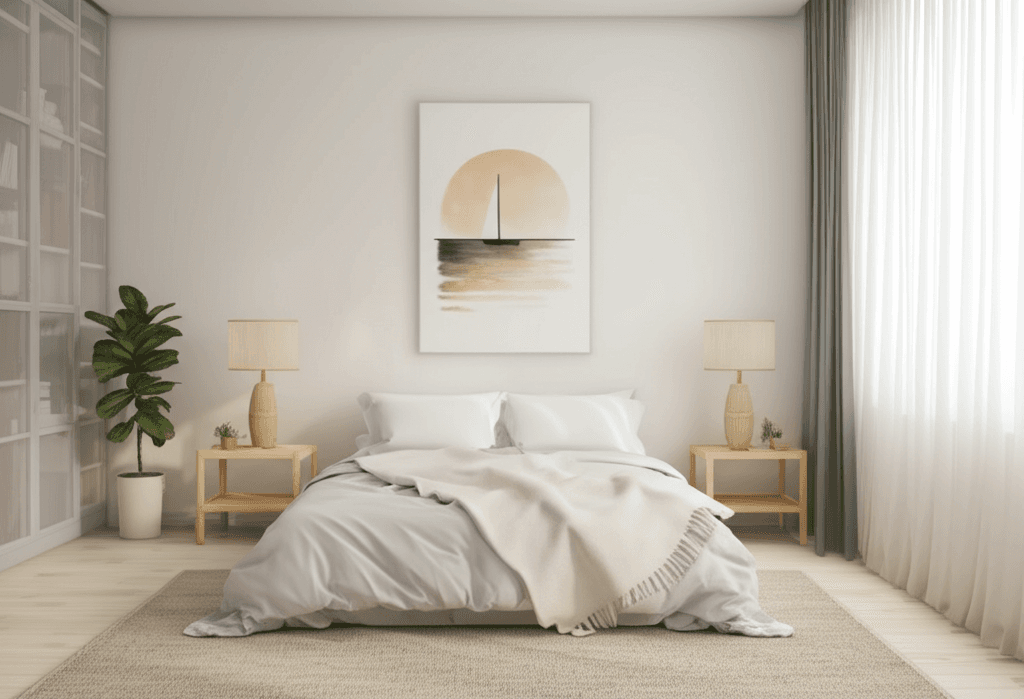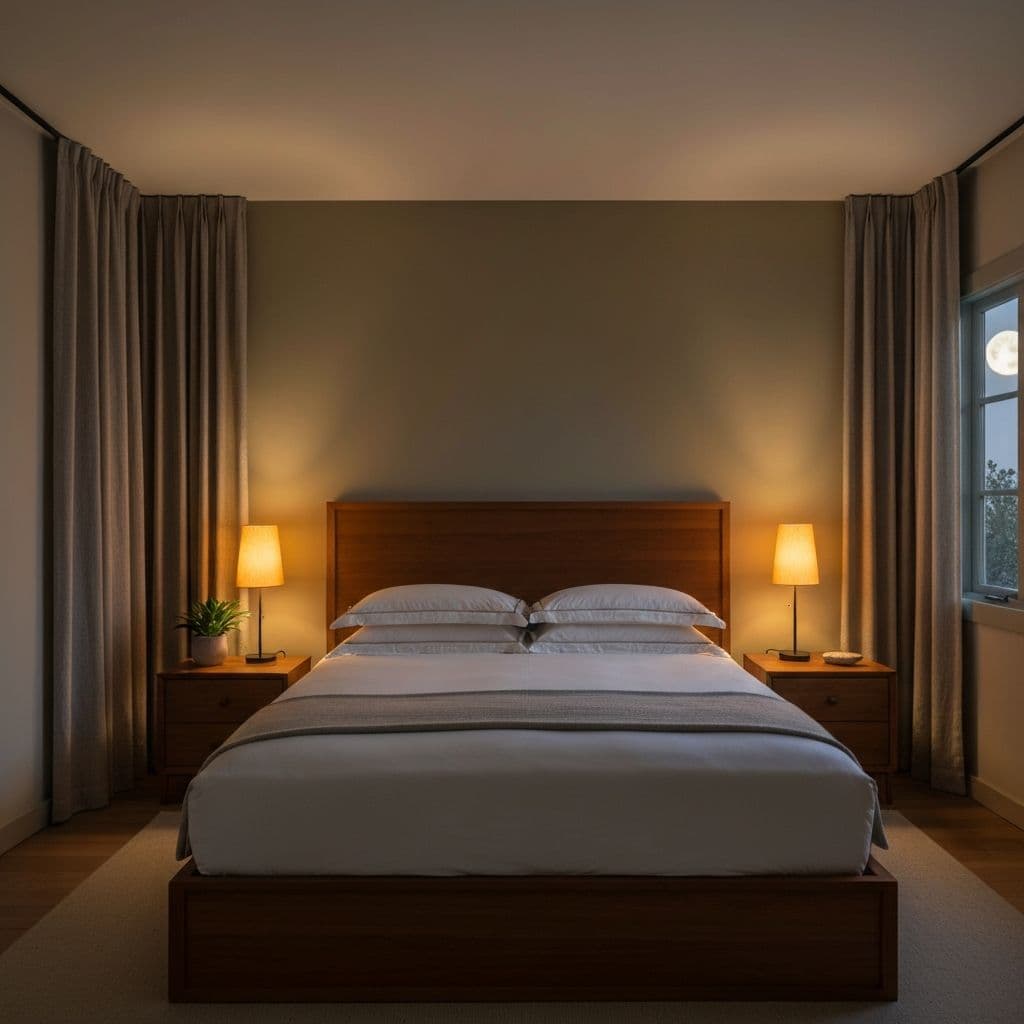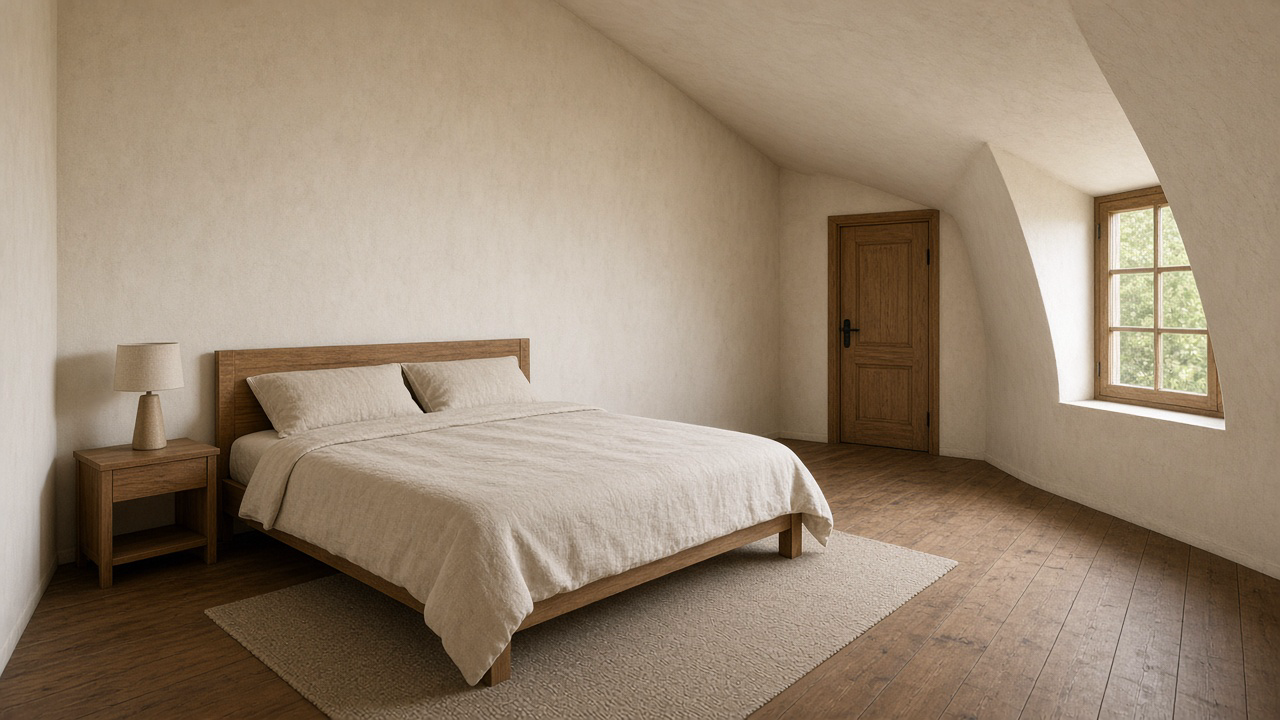

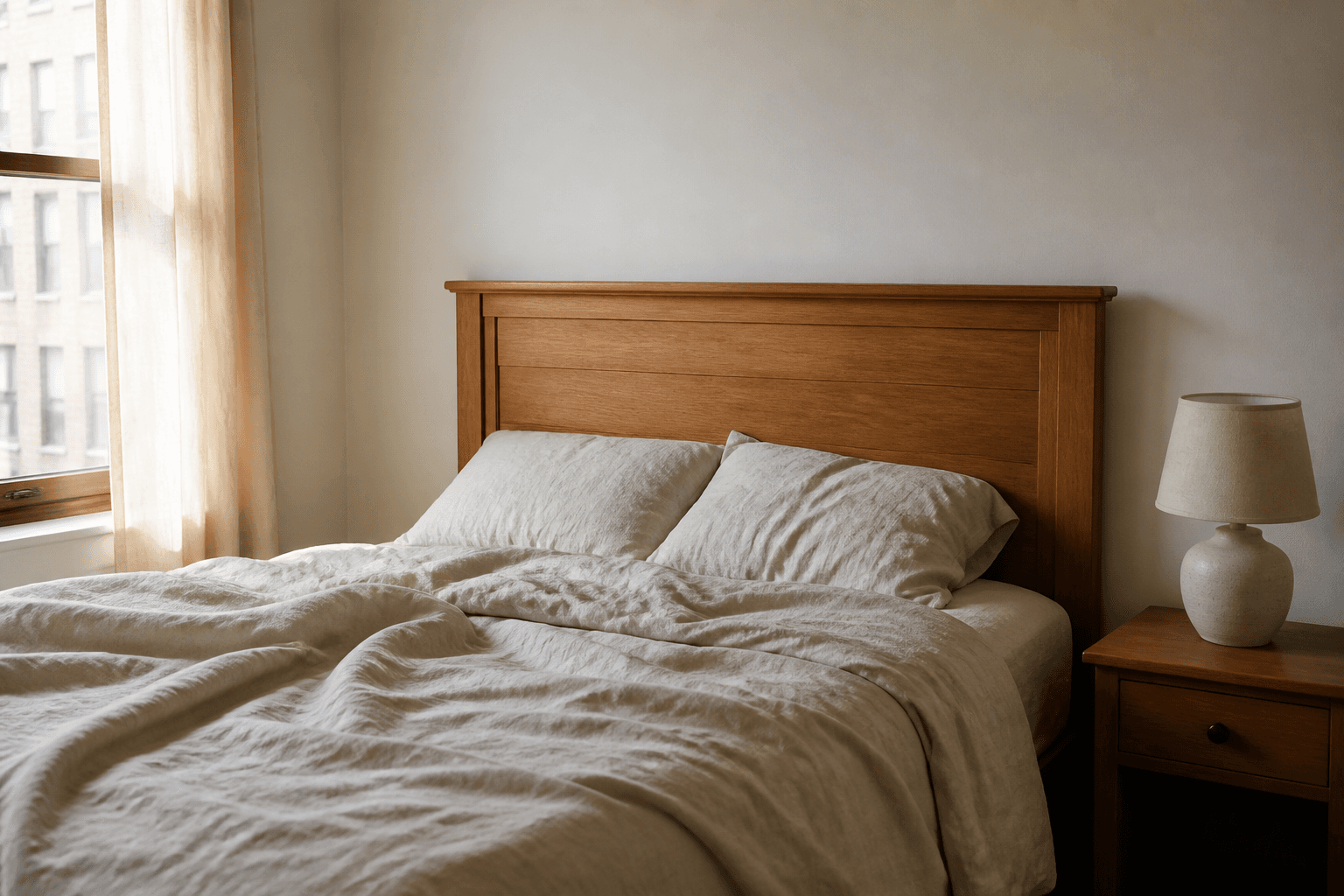
A Feng Shui headboard is a solid, reversible back behind the pillows so the bed has support from wood, a closed fabric plane, or a renter panel, not from a window or open bars as the only backing. You check this from the pillow. It is furniture work.
When we photograph bedrooms for analysis, the head of the bed is often the emptiest plane in the room. People buy a new duvet. The pillows still sit against a window or a metal frame you can see through. They ask which wood is lucky. We ask them to sit up. If the shoulders have nowhere to land, the bed is unfinished. This guide is that back, then the rental ways to add one.
What is a Feng Shui headboard?
You are deciding whether the sleeper's head has a closed plane behind it. If yes, the bed can do sleep. If the only backing is glass or open bars, the layout is still a daybed against a wall. Throw pillows that collapse after midnight do not count.
This is narrower than the full bedroom layout from the door. That page wants command position: you see the latch and you are not in the door's center line. A solid wall backs the head. A pretty frame does not cancel a mattress in the threshold. Fix the door geometry first if you can move the bed. Then look at what the pillows touch.
Classical Form School writing treats the wall behind you as a mountain. Popular books name that picture the Black Turtle and add stories about career support. Treat the stories as stories. Your upper back wants a stop. A bedroom that leaves the head in air or in a draft is a poor place to drop your shoulders.
A headboard is the movable half of that mountain. A solid board on a window does not turn glass into plaster. The usual rental miss is a metal frame on glass, with pillows doing the job of furniture.
Start from the sleep layout rules you already know. Screens off the duvet, a path you can walk in the dark, the door in view. Then check the head. Command position does not cancel a frame you can put your hand through.
Why does the wall behind the pillows matter?
Lie on your back. Sit up the way you do to drink water. Notice what meets your shoulders. That is the diagnosis.
Photos keep showing the same misses. A hotel-style metal grid with the cream wall showing through every gap. A mattress pushed under a sash so the pillows rest on the sill. None of that requires a theory about energy. It is enough reason to add a plane.
Couples folklore says a weak headboard means you lack support from a partner. We do not claim that. If you share the bed, do the sit-up test together. The person who has nothing behind them is the one the layout has to serve.
The lie-down support test
Do this in daylight and again after dark with the hall light on. A window wall that looks fine at noon can glare at 6 a.m.
- Lie where you actually sleep, not on a made-bed photo angle.
- Sit up. If your shoulders meet air or bars you can hook fingers through, mark that backing as a fail. Glass counts too.
- Look left and right along the mattress. If the board is narrower than the bed, the outer pillow has no back. Mark the gap.
- Walk in from the bedroom door. If the first thing you see at the head is a window or a bare frame, note it as unfinished, even if you cannot feel it from the pillow.
Write which backing failed. The next sections are only about those backs.
Is wood better than an upholstered headboard?
A closed wood plane is the default because it is rigid and opaque. Horizontal panels and a filled center read as a wall. Vertical slats with daylight between them fail the finger test. If you can see the plaster, you do not have a back.
Upholstery can do the same job. The test is the inner structure, not the fabric brand. A tall padded board with a closed back stops the eye the way wood does. A skinny padded rail bolted to a metal frame often leaves a stripe of wall above the pillows. Sit up. If you still see paint over your shoulder, the upholstery is too short.
Fabric also sags. A cheap pad can dish in the middle so the shoulders fall into a hammock. If you already own the oatmeal upholstered piece and the back is closed, keep it. Replacing it with "lucky" walnut is shopping. If the pad is collapsing, add a thin board behind the fabric.
The board should span the mattress and clear the stacked pillows. A twin panel behind a queen leaves a shoulder in space.
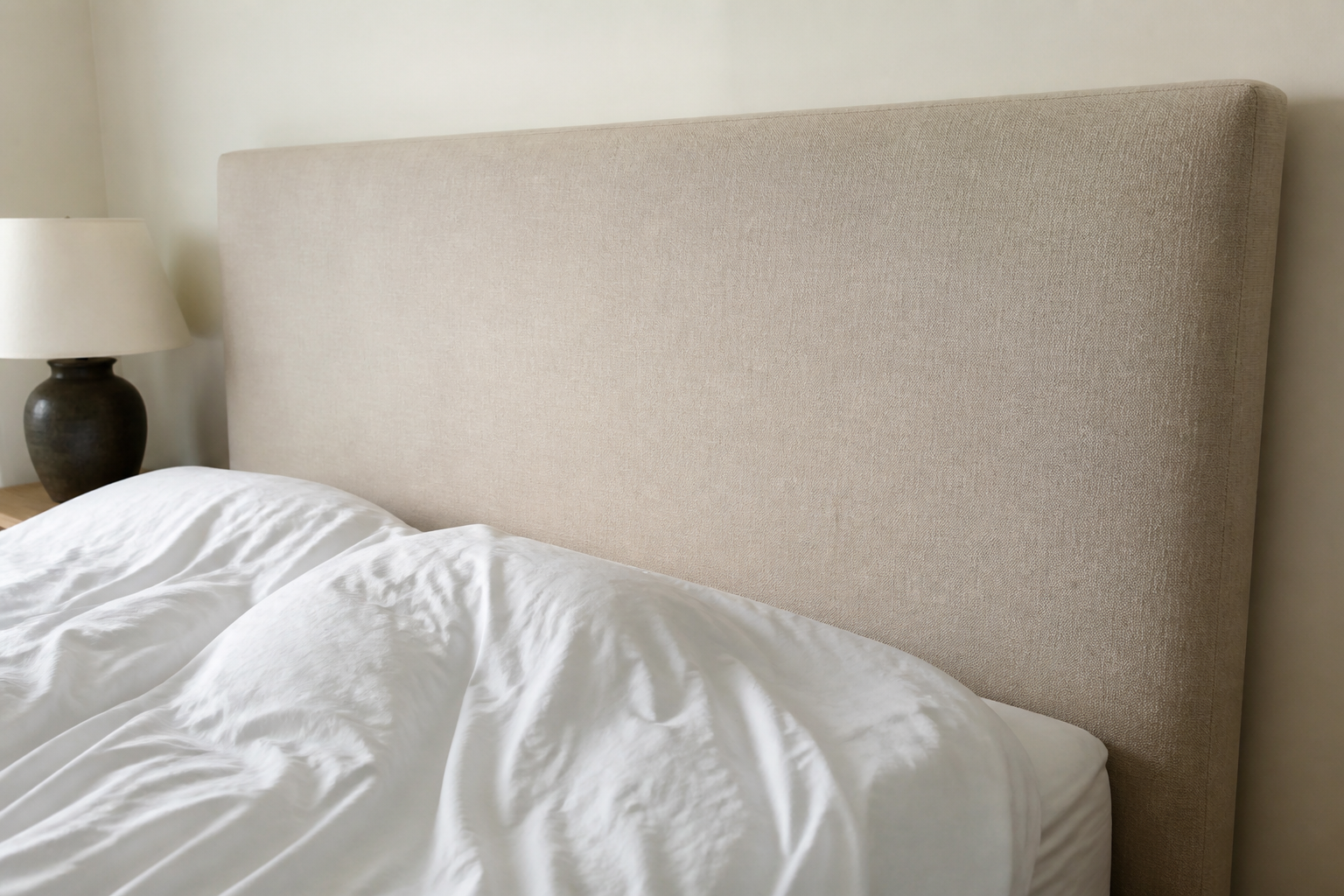
That tall oatmeal board is doing the furniture job. You cannot see through the fabric. Keep a piece like this. Do not swap it for open bars because a post said wood is the only "correct" material.
Open bars and a bookcase at the head
Metal grids show up in furnished rentals because they ship cheap. From the pillow they are a window with extra lines. If the frame unscrews from the side rails, take the grid off and slide a finished panel into the same slots. If it is welded, lean a board in front of it.
A bookcase headboard is storage on the skull. Objects sit over the pillow and a paperback slides. Put books on a side dresser. Keep the sleep wall as a plane.
Can a window be the only backing for a bed?
No. Glass is not a mountain. A window behind the pillows is draft and a view you cannot control when you sit up. Heavy curtains help the light. They do not turn the opening into a wall.
Move the bed if the room has another wall that still lets you see the door without lying in the threshold. That is the same command-position work as the bedroom layout page. People keep the bed on the window because the opposite wall has the closet or the door. Try a shift along the window wall first, so at least one pillow is on plaster. If the whole mattress only fits on the glass, you are in the compromise case, not the "windows are fine" case.
A radiator under that window does not count as support. Leave the airflow the lease expects. A slim panel that sits above the radiator is the renter version. Do not build a box around a landlord's pipes. If you wake facing a bright pane, add blackout on a tension rod inside the recess and pair it with a solid board.
If the bed cannot leave the window wall
Studios and small doubles often have one wall long enough for a queen. You will not get a full plaster mountain. You can still stop using the window as the only back.
Wedge a finished board between the mattress and the sill so the pillows land on wood or fabric. The board should be taller than the stacked pillows. Felt pads on the plaster side save the paint. A folding screen moves when you sit up; use it only if a board will not fit. Plants on the sill put water over the head. Keep pots on a side wall.
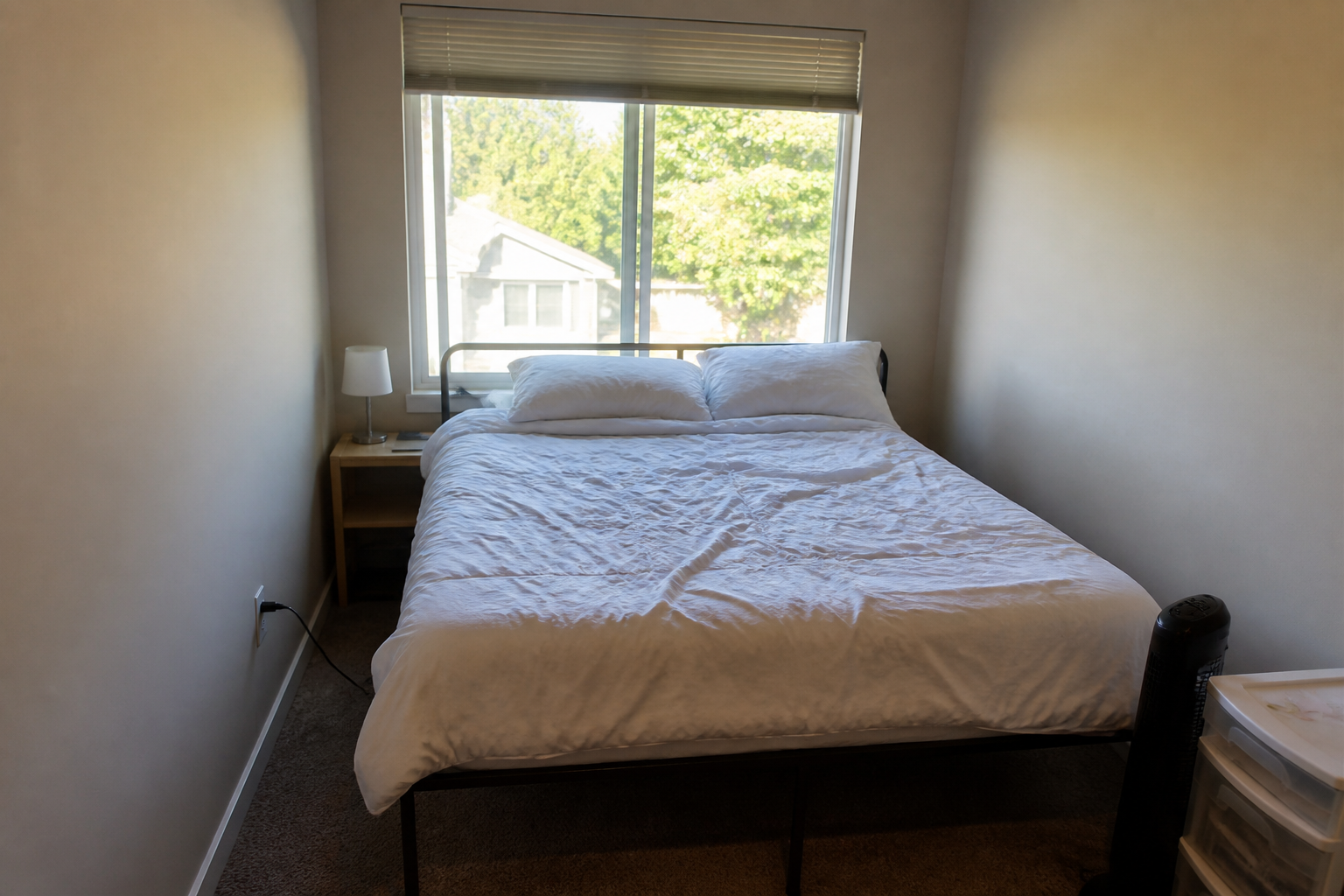
That metal frame on the window is the usual furnished-studio miss. There is no board. The only backing is glass, so the bed is performing as a daybed. If your pillow view looks like this, do not buy a lucky cushion. Add a panel and a drape, or move the frame.
Can renters add a headboard without drilling?
Most of the work is sliding and wedging. The renter furniture you can reverse page is the lease-level version. This section is only the sleep wall.
Use the headboard slots on the bed frame when they exist. A wood panel cut to the mattress width, finished on the room side, bolts to those slots the way the original grid did. Take the panel with you. Put the landlord's grid back if the inventory list named it.
If there are no slots, a freestanding board that leans on the wall and gets pinched by the mattress is enough. Felt on the plaster. Rubber on the floor feet if it has them. You should be able to pull the bed out and leave the wall as you found it.
Command strips hold fabric-covered lightweight panels on some painted walls. They fail on heavy oak. If the panel needs masonry anchors, choose a lighter board.
Do not unscrew a built-in window seat. Photograph the sleep wall before you add the board so the move-out email is boring. Buy height that clears the pillows before carving. Skip symbols on the face unless you already like that object.
A panel that leaves with you
Cut or buy a board the width of the mattress. Cover it with a throw you already own if the raw edge bothers you. Slide it down until the mattress edge holds it. If it rattles, add a folded towel at the floor line as a shim you can wash.
I would rather live with a plain boarded rectangle for a year than with a "designer" grid that leaves my shoulders in a draft. Support is the feeling of a back. It is not a superstition about timber species.
At move-out, pull the bed forward and lift the panel.
How should two people share one headboard?
One plane that spans both pillows. The couples bedroom pairing article is about matching nightstands and a shared path. The headboard is the shared back of that picture.
Two twin frames pushed together with two small boards and a gap down the middle read as a split even when you bought a coupler. Fill the gap with one wider board, or replace both small ones. You do not need matching carving. You need the shoulders to meet the same kind of stop.
If one person sits up to work on a laptop, offer a side-wall chair and keep the bed for sleep. A headboard is not a desk. Split king bases still can share one wide board. This page only asks whether both heads have a back.
What this is not
A headboard will not diagnose insomnia and it will not repair a relationship. It will not make you wealthy if the wood is walnut, and it will not ruin you if a hotel grid stays for a week while you wait for a panel.
Skip bagua-mirror hardware above the pillows. Skip medical claims about a "nervous system reset" from timber. If sleep is a health problem, that is a clinician's job. This page is a back for the bed.
Write down what you changed. The next time you move, you will remember that the window wall looked bright in the listing and felt like a bus shelter by Thursday.
A simple evening checklist
Do this in order. Stop when the sit-up test meets a closed plane.
- Lie down, then sit up. Name the backing: wall, wood, fabric, bars, glass, or air.
- If the board is narrower than the mattress, mark the open shoulder.
- If the backing is bars or slats, plan a panel in the frame slots or a leaner in front of the grid.
- If the backing is a window, try another wall that still sees the door. If you cannot move, add a board plus a drape.
- Pull pillows used as a fake mountain. They are bedding, not a wall.
- Photograph from the pillow in FengShui Hero and compare the flagged wall with the plane you just added.
If you share the room, repeat the sit-up with the other person. The "correct" blog layout is useless if one sleeper still meets glass every time a bus goes by.
If you only do one thing tonight, sit up and check whether your head has a closed plane behind it. If the answer is glass or bars, slide a finished panel in before you shop for a new frame.