
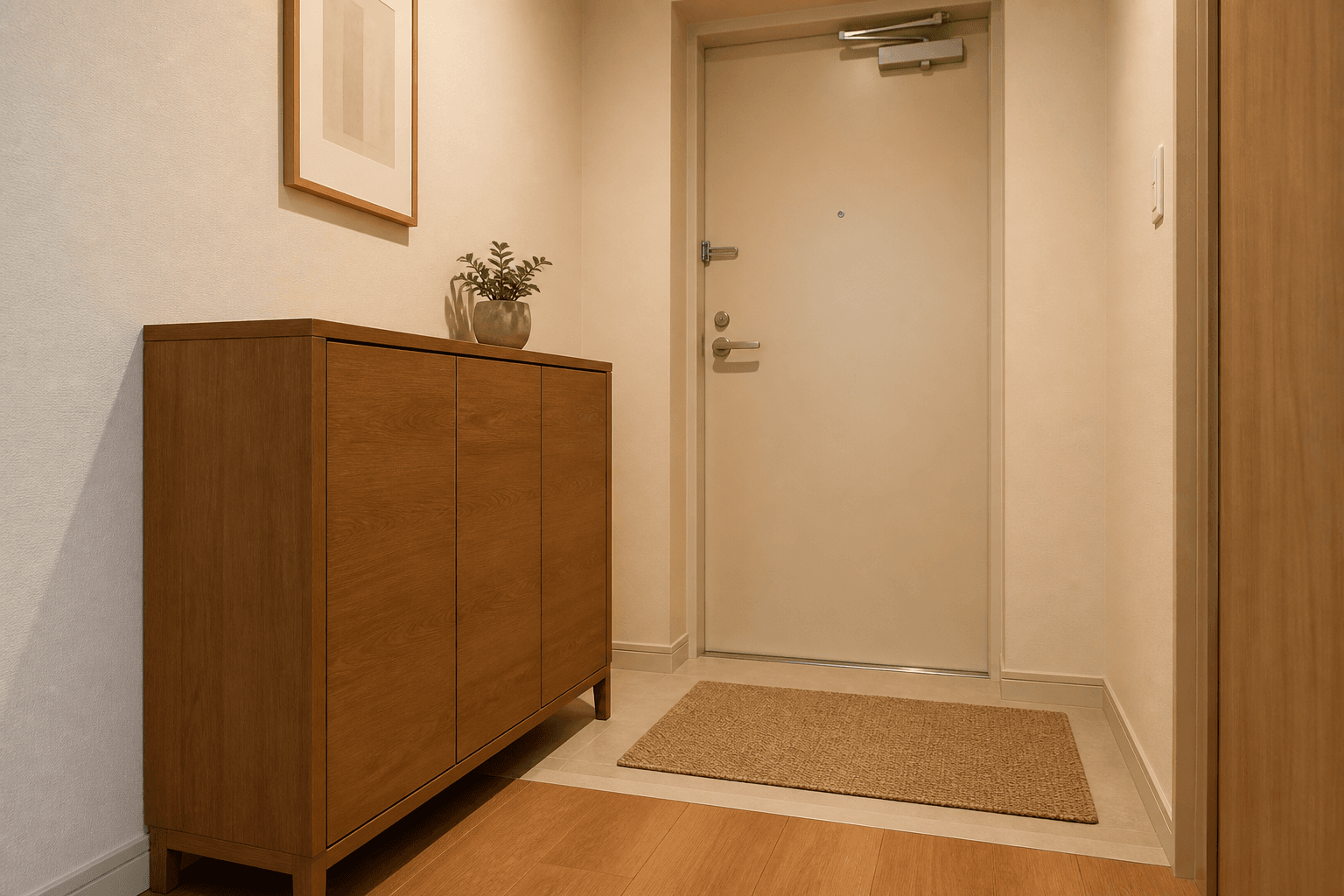
Feng Shui shoe storage is a closed cabinet or a lidded box beside the door so daily pairs are hidden and the walk stays clear. An open rack still shows soles. You hide shoes. You do not block the latch.
When we photograph entries, the mat is doing three jobs: wipe, park, and archive. People ask whether shoes facing inward bring luck. We ask whether the door can finish its swing. The hallway clutter page is the corridor after the first meter. The front door mat page is the rectangle on the floor. This page is hidden versus open storage at the mouth of the house.
What is Feng Shui shoe storage?
You are deciding whether arriving people see a wall of used soles. Form School wants a walk you can take without a pile. Popular posts say shoes carry dirty qi from the street. Treat the qi talk as optional poetry. Dirt, smell, and visual noise are enough.
This is narrower than the full entryway. Light, swing, and a table for keys still matter. The cabinet is the shoe-specific piece. A pretty bowl of keys on top of an open rack does not hide the trainers.
Closed doors are the default. Vents or a small gap at the plinth help smell. A sealed plastic tub of wet shoes is a science experiment. Let them dry, then hide them.
Start from the pairs you wore this week. If the tower is last winter's boots plus guest flip-flops plus a dead pair, you do not have a Feng Shui problem. You have a closet problem.
Is an open rack always wrong?
An open rack is a step up from a heap. You can still trip. You still see it every time the door opens. In a tiny studio, an open rack against a side wall may be the only furniture that fits. Then you owe it a cover: a curtain on a tension rod, a folding screen, or a habit of putting extras in the bedroom.
Do not aim open shelves at the person who enters. Side-on is less of a billboard. Low is better than a tall tower that becomes a second wall in a narrow hall.
Toes in versus toes out is folklore. Point them so the door can close. That is the test.
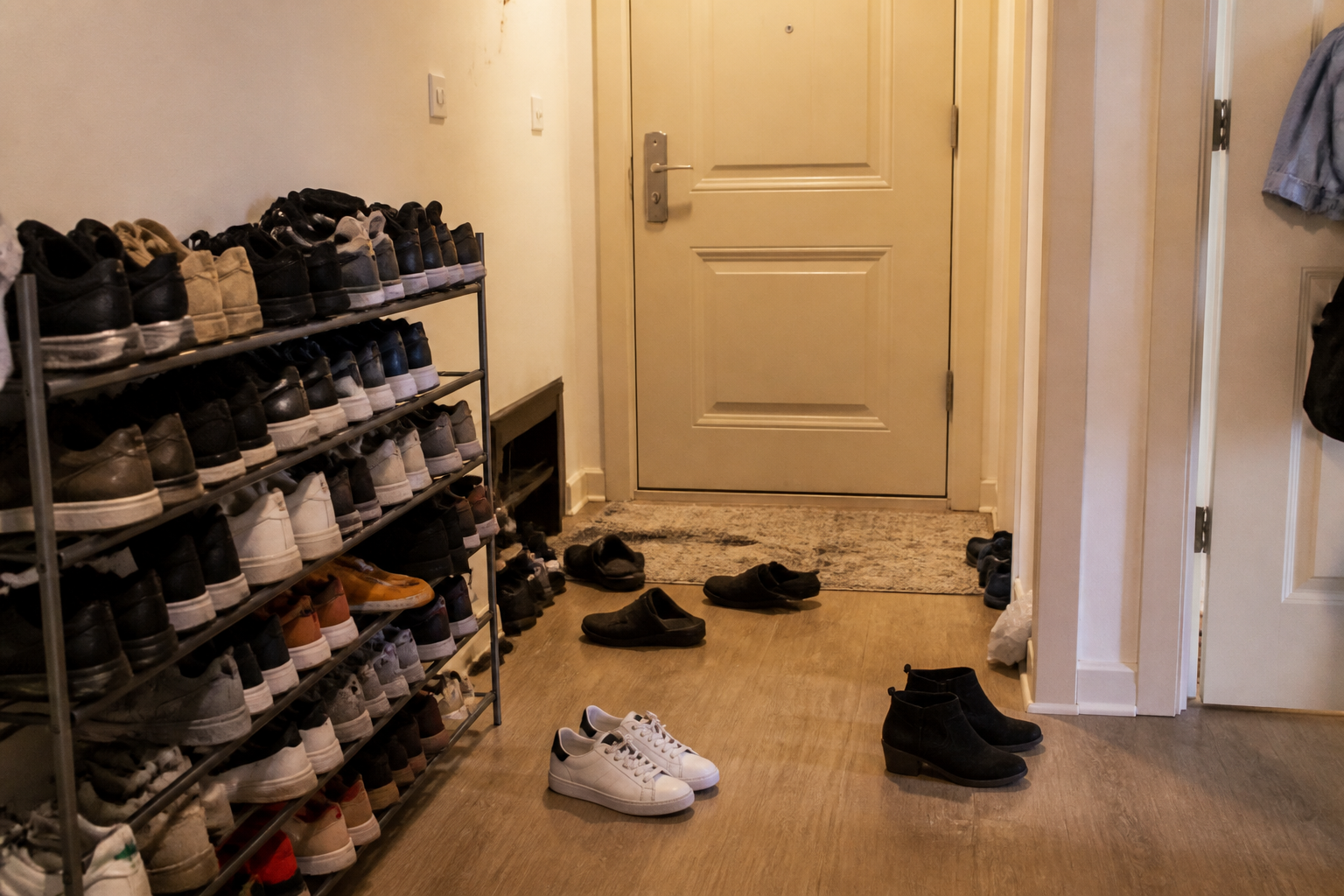
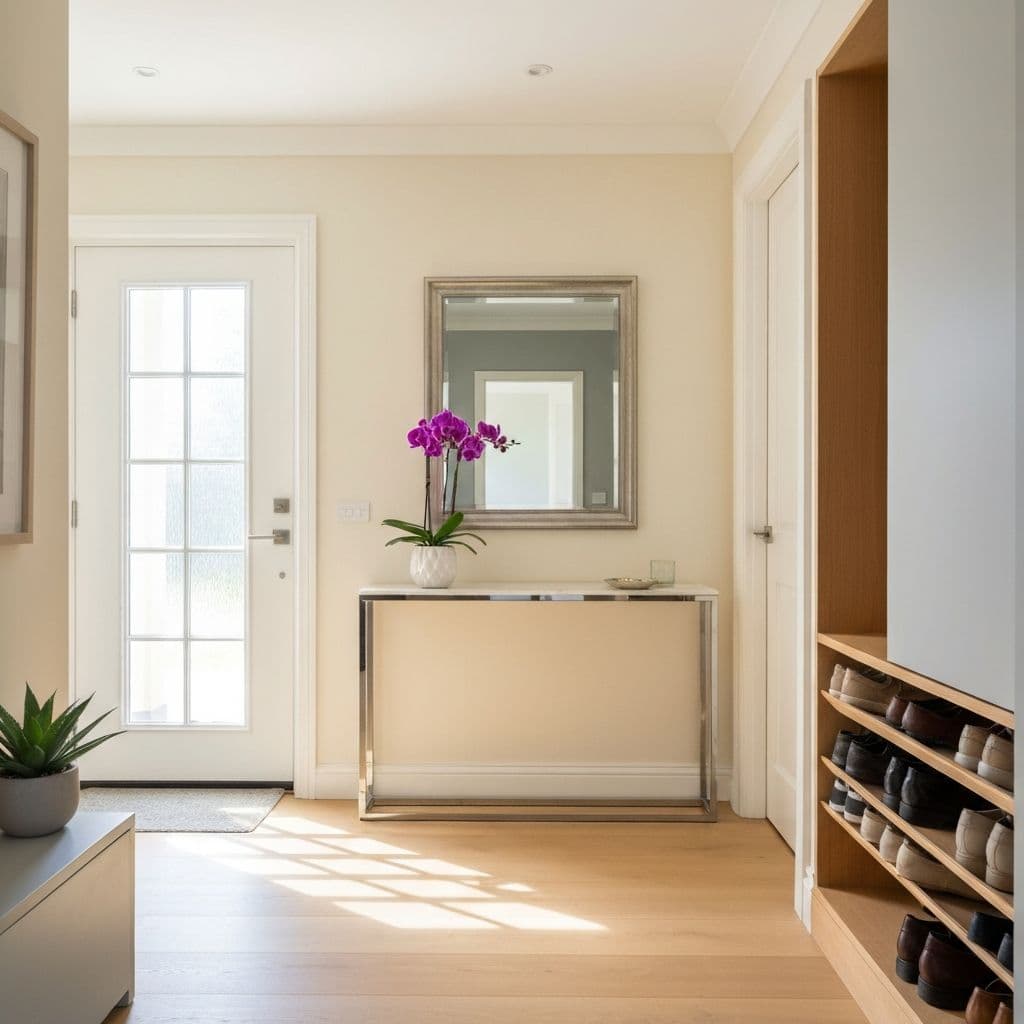
That rack is organized and still a mess in the first sightline. If your entry looks like this, add doors, a curtain, or move the extra pairs. Do not buy a lucky number of tiers.
Where does a closed cabinet go?
Beside the swing, not in it. Trace the leaf with the door open. The cabinet lives outside that arc. In a Japanese-style genkan, the cabinet sits on the raised floor while the mat sits on the tile. In a flat with one level, keep the cabinet against a side wall so two people can pass.
Height: low enough that it does not eat the face of the room. A tall wardrobe of shoes in a 90 cm hall is a tunnel. A bench with a lid gives you a seat to put shoes on. That seat is useful. Do not stack boxes on the lid until it cannot open.
If the only wall is opposite the door, a closed cabinet there is still better than an open rack there. You see wood, not soles. Keep a lamp so the first meter is not a cave.
Shared corridors in a building are not your bagua. Fire rules win. Do not annex the landing with a household rack.
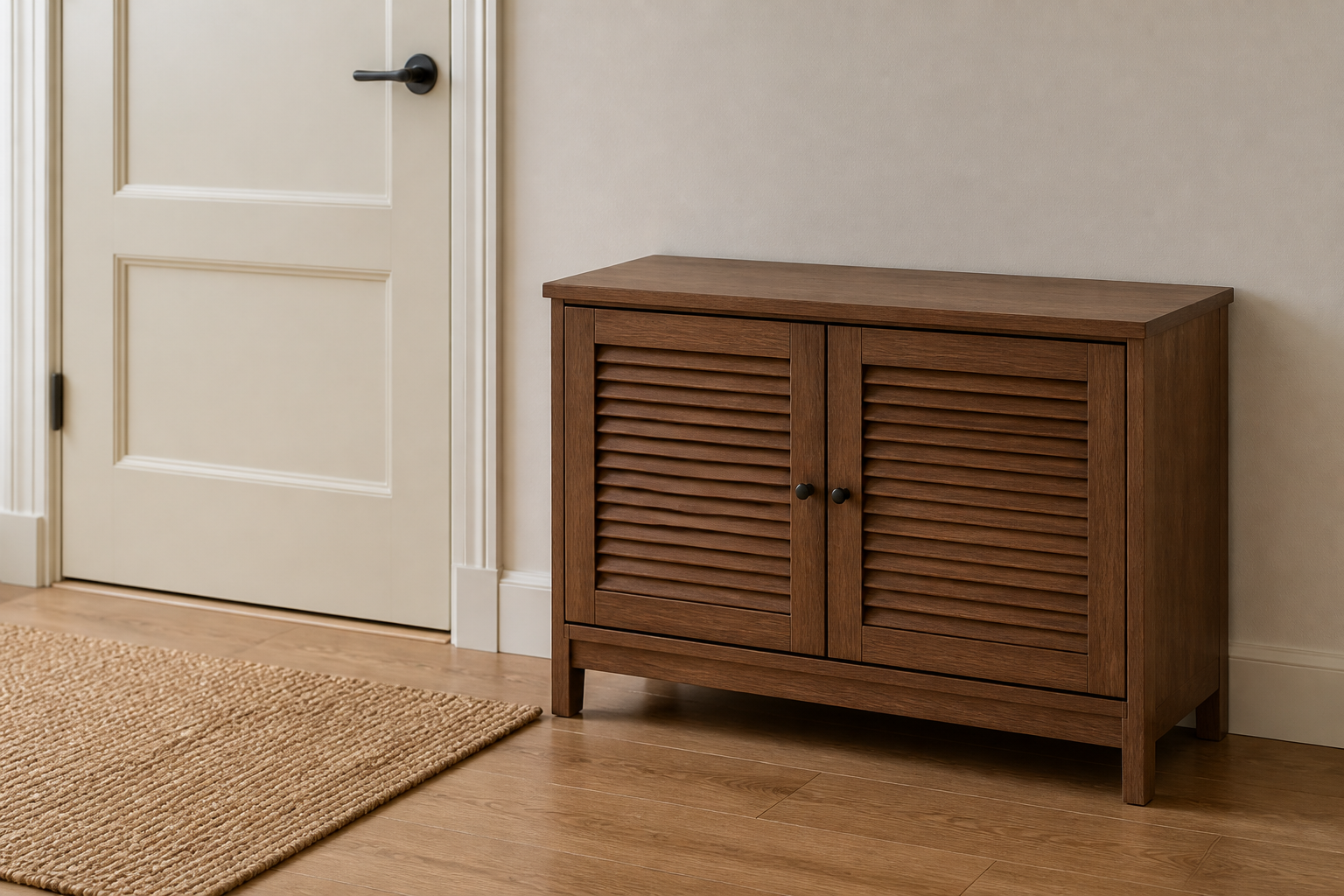
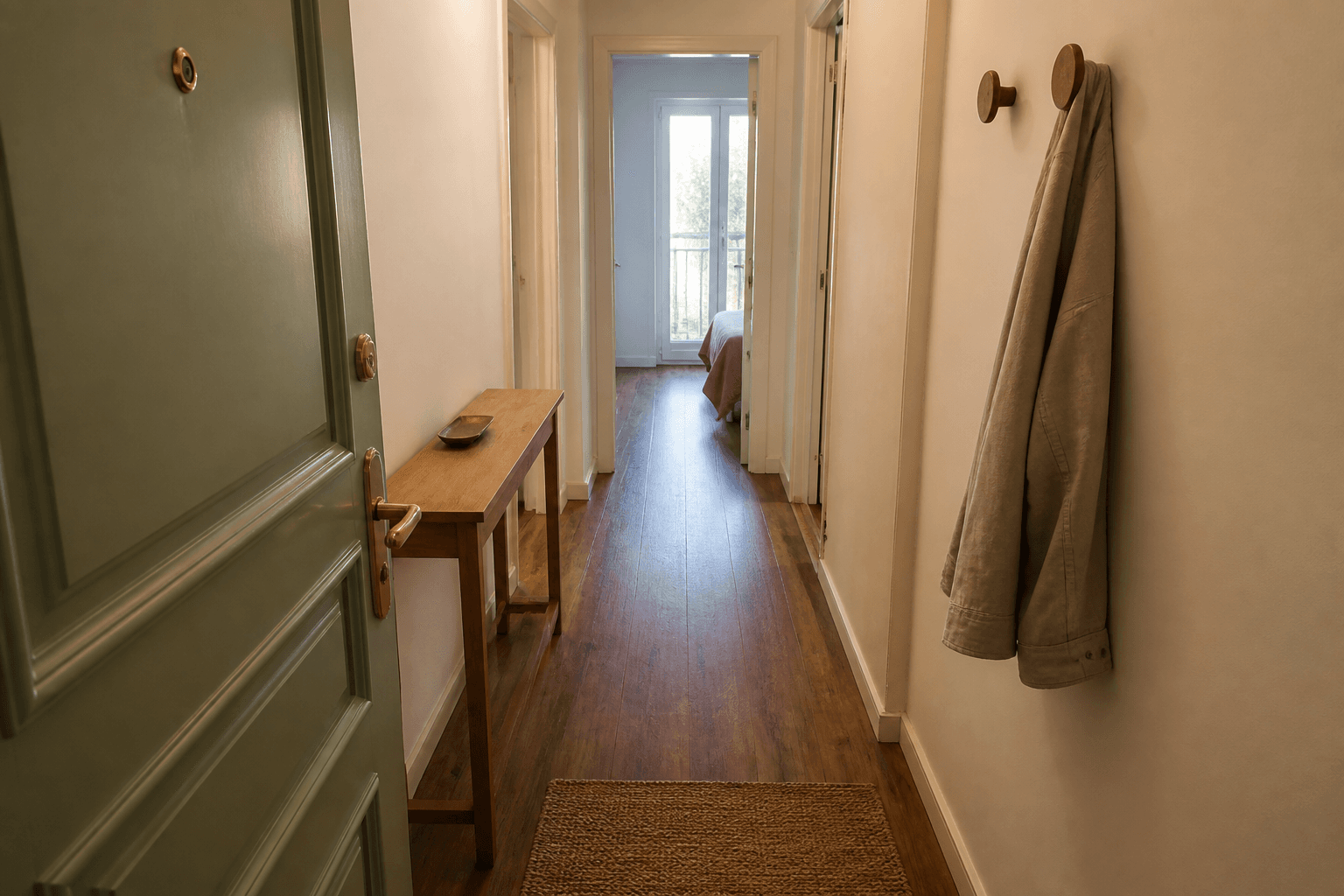
That cabinet is doing the hide job. The mat is free to wipe. The walk is a person wide. Copy this even if the wood is uglier than the photo.
Smell and wet pairs
Wet mesh in a closed box overnight is how you get a biology project. Dry on a tray, then put away. A packet of bicarbonate in the cabinet is housekeeping. It is not a cure.
Throw dead pairs. A sole that flaps is clutter with laces.
Can renters hide shoes without drilling?
A cabinet on legs. A lidded ottoman. Fabric bins with lids on a low shelf you already own. Tension-rod curtain in front of an open rack. All of that reverses.
Skip masonry. Skip painting the cabinet red for luck. Photograph the entry so move-out is boring.
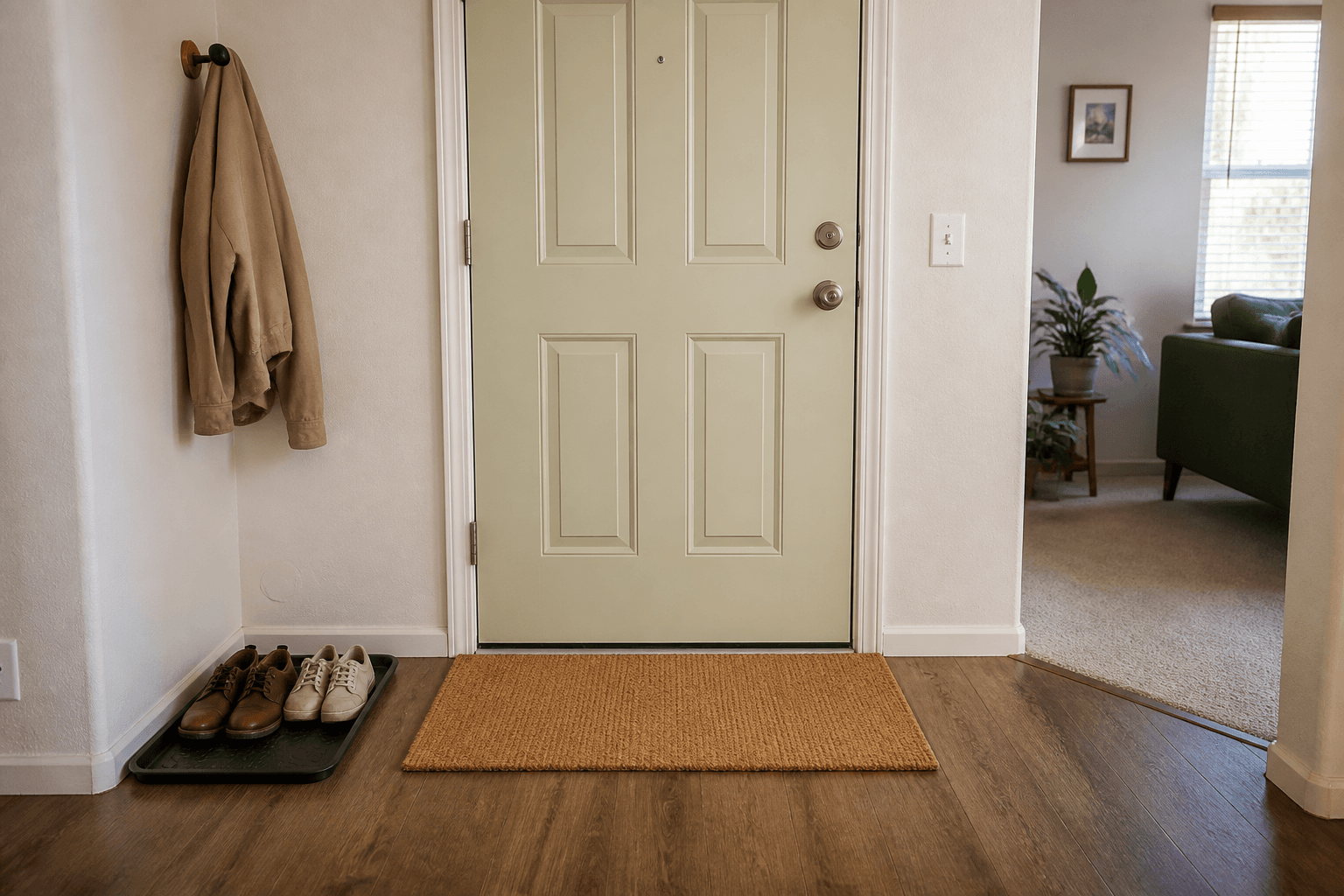
If you cannot fit a cabinet, the one-pair rule is the whole method: today's shoes on a tray, everything else in a closet you already have. That closet can be the bedroom. The mouth of the house does not have to archive the year.
How we check shoes at a real latch
We open the door fully, then we look at the floor in the swing, then we look at the first sightline. If the leaf hits a trainer, the cabinet is in the wrong arc. If the first thing a guest sees is a wall of soles, the storage is open or it is aimed wrong. If the mat is a parking lot, the cabinet is too far away or it is full of pairs nobody wears.
Wet weather is its own tray. Today's muddy pair dries in the open for an hour, then goes behind a door. A closed cabinet packed with wet mesh is how you get a smell that people blame on "sha." It is biology. Dry, then hide.
Guest pairs get a basket with a lid that lives in a closet, not a permanent extra rack in the mouth. If guests come weekly, a second lidded box on the side wall is still closed storage. It is not permission for an open tower.
Sports bags and a bike are hallway objects. They steal the shoulder. Park them after the first meter, or in a room, or in the building store. The shoe cabinet cannot also be a gym.
Closed versus open versus none
| Setup | What you see from the latch | Renter notes |
|---|---|---|
| Closed cabinet or lidded bench | Wood or fabric, not soles | Best default if it fits beside the swing |
| Open rack, side-on, covered at night | Soles unless you add a curtain | Tiny hall compromise |
| One-pair tray, rest in a closet | Almost nothing | Best when the hall is 80 cm |
Left versus right of the door is folklore in some popular posts (dragon and tiger talk). Put the cabinet where the swing allows it and where two people can pass. If both sides work, pick the side that does not become a dumping table.
Outdoor shoes versus indoor slippers is a household rule, not a gua. If you change at the mat, the cabinet still hides the outdoor pairs. Slippers can live in a small closed box so they are not a second pile.
Wipe the cabinet top. A plant is fine if you water it. Mail is how the top becomes a cliff. The entryway article is that cliff. This page only asks whether the shoes are behind a door.
If the building has a shoe-off culture, put a small stool you can move so people are not hopping in the swing. The stool lives beside the cabinet, not on the mat. At move-out, the stool leaves with you.
A weekly wipe of the cabinet interior is housekeeping. Grit left in a closed box is still grit. Feng Shui does not replace a vacuum. It just asks that the vacuum not live in the first sightline.
If you share the entry with a partner, agree on a pair budget. Two people's "this week" can still fill a tower. Split a shelf each behind the same doors rather than adding a second open rack.
What this is not
Shoe storage will not raise income, luck, or the rent you can charge. A closed door on a cabinet will not "contain sha." It will contain the look of dirt.
Skip Vastu-style rules about northeast versus southeast unless that is the practice you hired. This page is Form School at the latch: hide, clear the walk, dry the pairs.
Skip a charm on the cabinet top if the top is already a plant plus mail. One object.
A simple evening checklist
Do this in order. Stop when the door can swing and you cannot see a wall of soles.
- Open the front door fully. Mark what it hits.
- Count pairs at the entry. Move anything you did not wear this week to a closet.
- Put the rest in a closed cabinet, a lidded bench, or a covered rack on the side wall.
- Leave one tray at the mat for today's wet pair.
- Wipe the mat. The mat article is the weave. This page is the box.
- Photograph from the latch in FengShui Hero and compare the flagged pile with the cabinet you just used.
If you only do one thing tonight, put every pair you can see into a closet or behind a door. An empty walk beats a lucky open rack.