
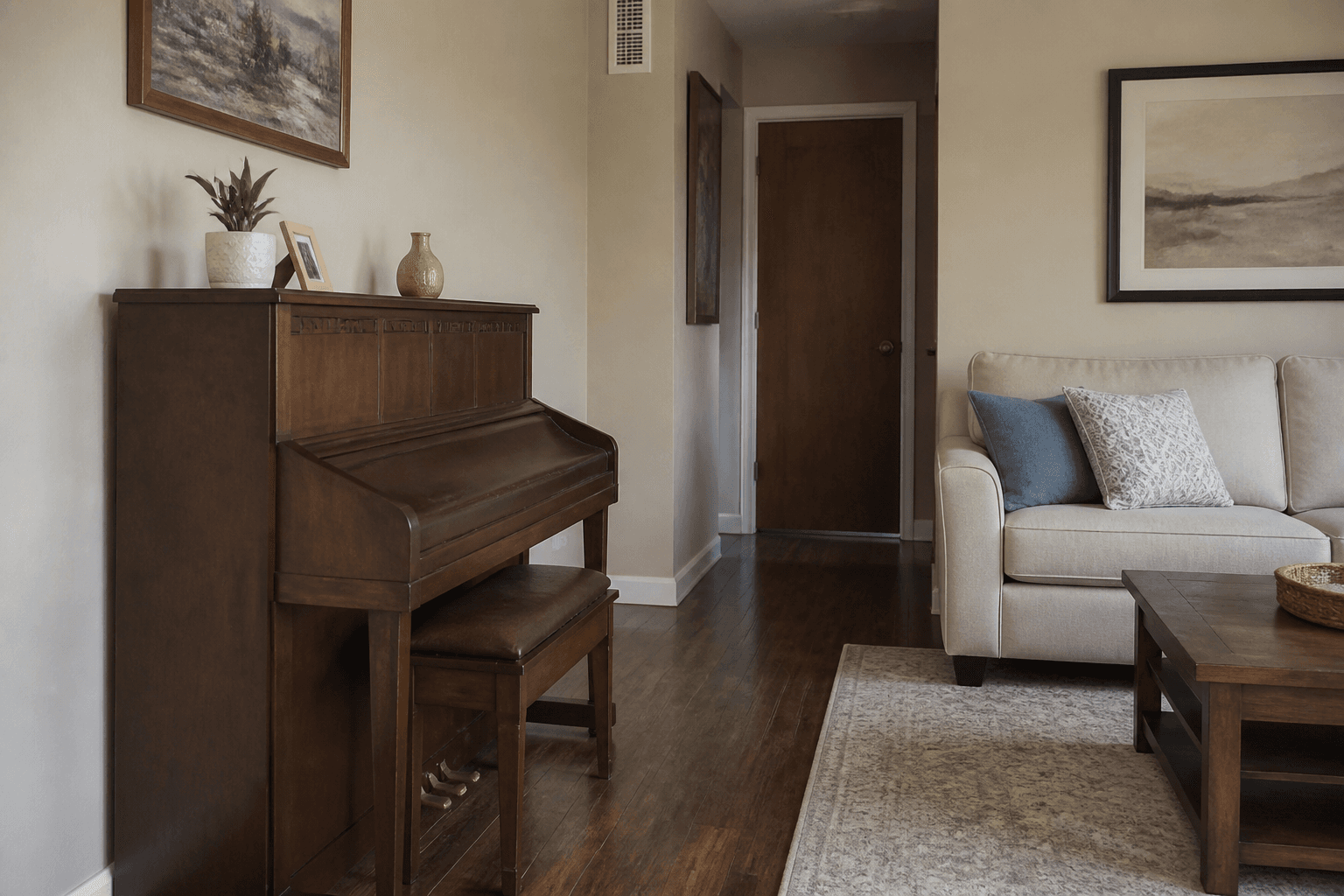
Feng Shui piano placement is a lid that stays off the walk when it is open, a bench that does not put the player's back to the room door, and a case on an interior wall that is not a shared bedroom wall if neighbors sit on the other side.
When we photograph living rooms, the piano is often the piece nobody moved after the delivery crew left it on the first long wall. The lid is up. The bench sticks into the path between the sofa and the kitchen. The player faces plaster. People ask which gua likes music. We ask them to sit on the bench and name the door. This page is the instrument as furniture in a home. The sofa placement guide is the seat. The living room layout guide is the family circle. A piano is a sounding box with a lid. It is not a lucky charm.
What is Feng Shui piano placement?
You are giving the case two jobs that fight. Someone should be able to walk past it with a laundry basket. Someone should be able to sit and play without turning their spine toward every knock.
Form School cares about what a large object does to a path and to a person's back. Popular blogs add a sticker: music belongs in children or in knowledge, so the tower in that square will make a household artistic. Treat the sticker as optional. A pinched aisle is the actual miss.
This is narrower than how you arrange furniture for the sofa and the desk. Those pieces already have a command test. The piano gets the same test, aimed at the bench, plus a lid that becomes architecture when it is open. Do not rebuild the conversation circle to chase a map square. Fix the walk and the player's view of the latch first.
An upright is a tall, heavy cabinet. A small digital is a slim keyboard on a stand. Both occupy a hip line. Both grow a second footprint when the bench is pulled out. Measure that second footprint.
The sit-and-walk test
Do this before you buy a metronome stand.
- Sit on the bench as if you will play. Can you see the room door without twisting all the way around?
- Open the lid or the fallboard the way you actually practice. Walk from the door to the kitchen. Do you turn sideways?
- Knock the wall behind the case with a knuckle. Does it sound like a neighbor's bedroom, or like your own closet?
- Look at the closed lid. Mail pile, plant, or clear wood?
Write which failed. The next sections only fix those.
Should the piano lid stay open?
Close it when nobody is playing. An open lid on an upright is a wood triangle that eats the aisle. It also keeps the instrument visually on, the same way a black television stays on when the show is over. You walk to the fridge and you keep seeing a mouth of strings.
The fallboard (the strip that covers the keys) is the part most people slam. Set it down. A slam is noise for the room and for whoever shares the plaster. Dust and pets are the boring reasons to close it. A cat on an open keyboard is a 2 a.m. concert you did not schedule.
A grand lid is a different wing. Most rentals never see one. If you have one, aim the open lid away from the walk and close it when you stop.
The closed lid will attract mail and a plant you forget to water. That pile is a sideboard you did not mean to build. Keep the top clear, or you will never close it because you would have to move the pile first.
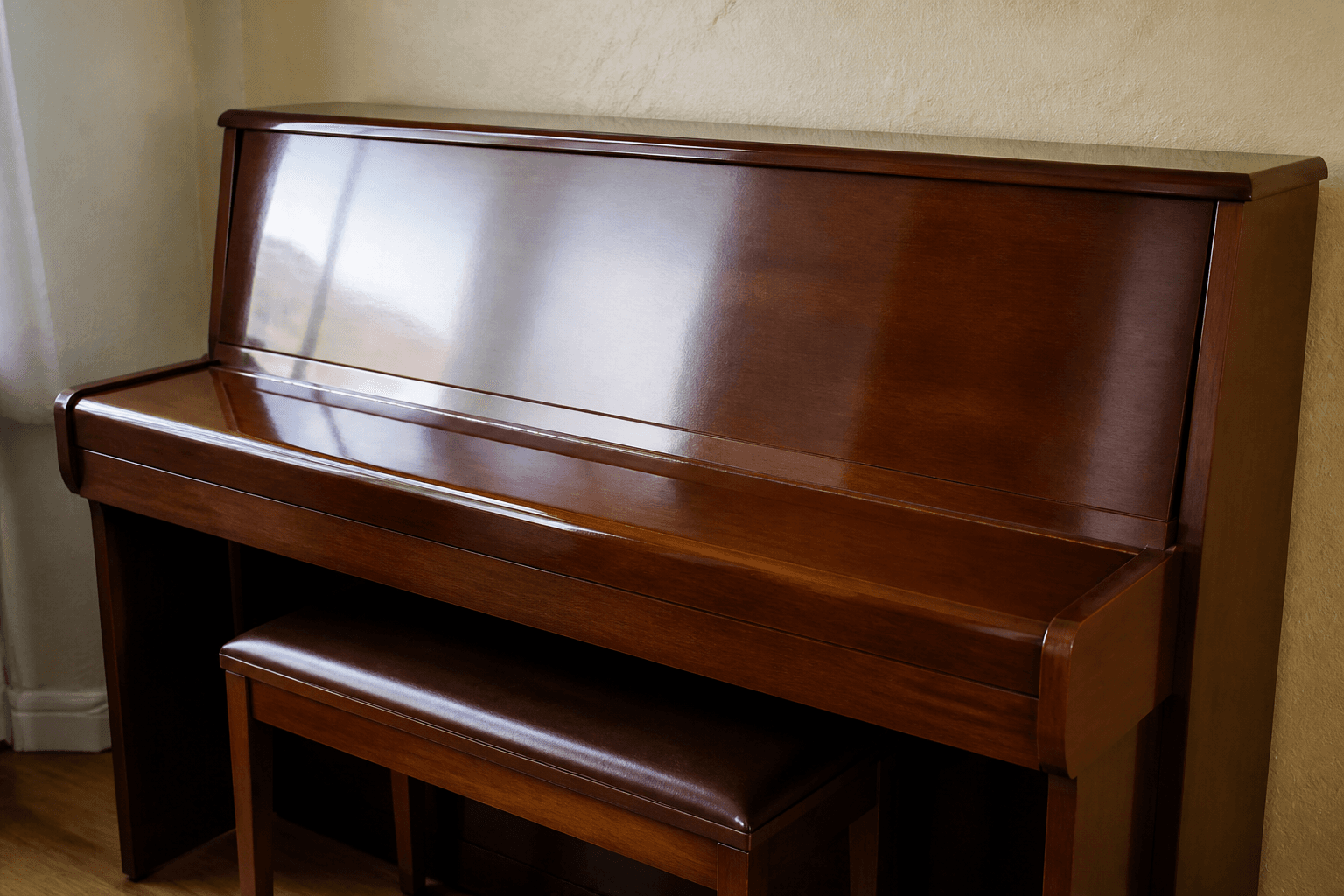
That tucked bench and closed lid are the quiet state for the hours you are not practicing. The case can stay. The triangle of open wood does not need to stay.
Does the piano steal the walking path?
Stand in the room door. If the first squeeze is between an open lid and a sofa arm, the piano is already running the layout. People blame the sofa. Move the bench in, close the lid, then judge the sofa.
The bench is a second object. Pulled out for a player, it is a coffee-table problem at hip height. Tucked under when you stop, it is furniture again. If the bench cannot tuck because of heating pipes or a thick rug, you chose a bad wall.
Leave a pass you can walk without turning sideways. A fake gap you sidle through is clutter with extra steps. Tape the floor along the lid's open edge if you cannot see it in your head. If your hip hits the tape, the wall is wrong or the lid must stay down except during practice.
Do not park the case in the door swing. An entry that hits wood every time someone comes home is a startle, and it is hard on the finish. Slide until the swing is empty, even if the case sits a few inches off center.
In a studio, an upright can divide sleep from sitting. That only works if the kitchen path still exists. A piano that becomes a dam to the fridge fails the home job.
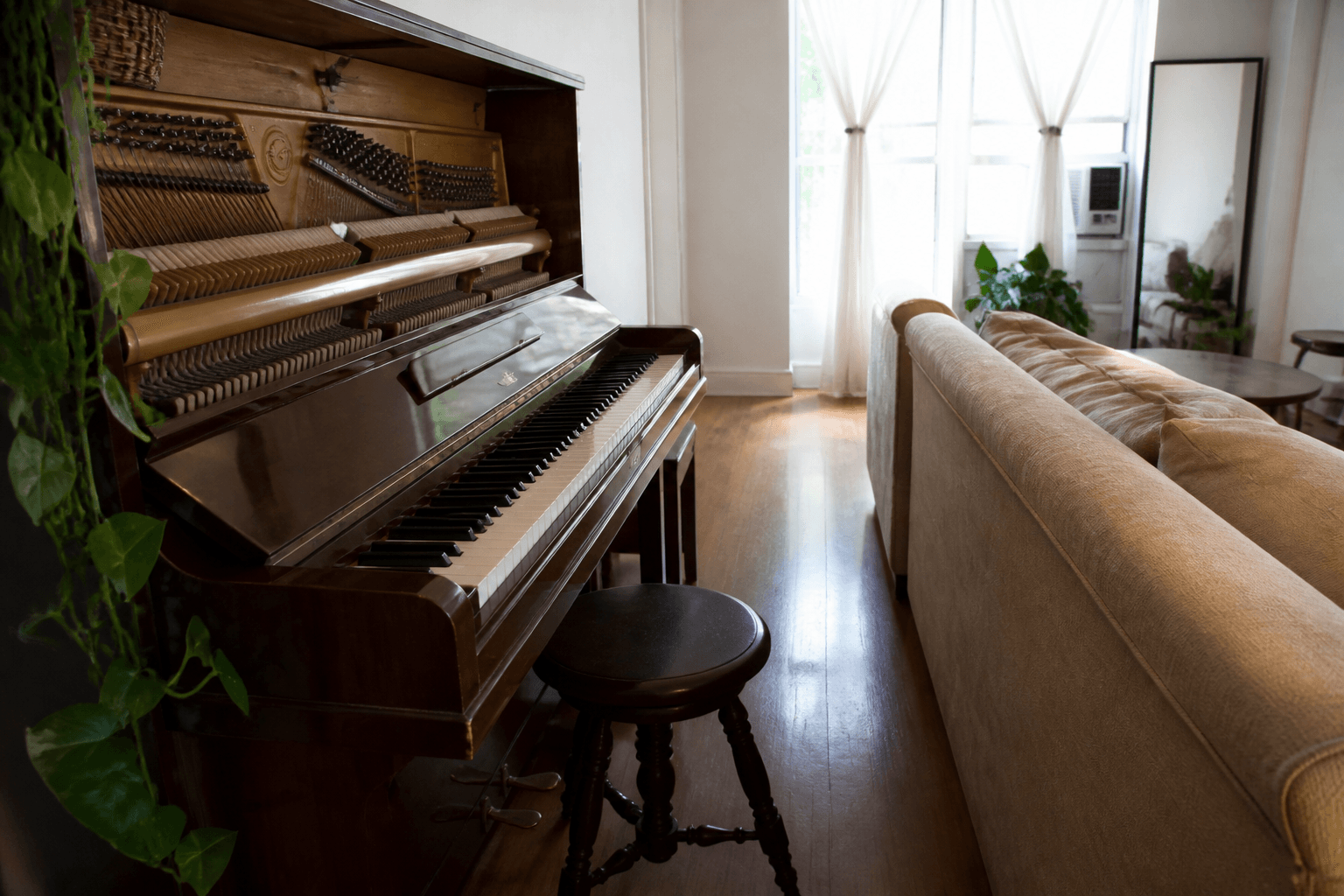
That pinch is the diagnosis. The sofa can be fine. The lid is the extra wall. Close the lid and tuck the bench before you buy another rug.
Can the player see the room door?
Command position for a piano is the same idea as a desk: the person sitting there should see who enters. You do not need the latch in the middle of the music rack. A glance to the side is enough.
The usual miss is the delivery line. The case goes flat on the long wall. The player faces plaster. The door is behind the left shoulder. Every person who comes in is a surprise. People call that bad energy. In ordinary language, you cannot say hello until they are already at your elbow.
Angle the case a little if the room allows it. A few degrees can put the latch in peripheral view without pointing the soundboard at a neighbor wall. If the room is a tight rectangle, keep the case parallel and shift it so the bench sits closer to the door wall than to the far corner. You play toward the room, not toward a closet.
A window in front of the rack is afternoon glare on the page. Pull a sheer, or put the case on a wall that is not the sunset. Prefer a solid interior wall behind the player.
I would rather have a slightly crooked case that sees the latch than a perfectly centered upright that turns the player into a cave. You can live with a gap at the baseboard. You cannot finish a scale if every knock makes you crane.
What if neighbors share the wall?
Sound is form. An upright against a neighbor's bedroom wall sends bass and lid noise into a room you will never photograph. That is a manners problem before it is a map problem.
Knock. A hollow, live sound often means a bedroom next door. A duller sound can mean a stair or your own closet. You will not get a perfect read through rental plaster. If you already talk to a neighbor, ask. If you do not, assume a shared bedroom is possible and pick another wall when the length fits.
Prefer an interior wall inside your unit, or a wall you share with your own closet. Exterior walls can be colder and drier, which is a wood-care issue for an acoustic. A digital cares less about humidity and still cares about the walk.
If the only long wall is the shared one, reduce what travels. Felt or rubber cups under casters help. Close the lid when you stop, and keep practice hours that match the building. Headphones on a digital are the renter version of a practice mute. Do not drill a hanging keyboard into landlord plaster if the lease forbids holes.
Casters on vinyl will creep when you play loud. Then the case drifts into the path you just cleared. Cups stop that. Take them when you move.
Should you use an upright or a small digital?
Pick the instrument you will play. Then run the same tests. The furniture difference is mass and lid shape. Shared-wall sound is the other difference.
| Instrument | What it does to the room | What to watch |
|---|---|---|
| Upright | Tall cabinet, fallboard, real weight | Open lid pinch, shared-wall bass, casters |
| Small digital | Slim stand, light, often a slide cover | Cable tangle, plant on the keys, stand wobble |
| Small grand (rare) | Lid as a sail | Aim the sail off the walk, close when done |
A small digital can sit more like a console. That makes it easy to become a dumping table. Keep the top for a lamp at most. Clip cables to the stand.
Headphones do not cancel command. You can still sit with your back to the door and flinch when someone enters. Place the stand so a glance finds the latch.
If you already own an upright and you hate the wall, felt sliders that take weight let renters test a second wall. Measure doorways first. Some uprights do not turn a hallway corner. Then the "wrong" wall is the only wall, and lid plus hours do the work.
How we check a piano wall
We photograph from the living-room door. If the first object is an open lid in the hip line, the path fails. If the first object is a bench in the walk, the bench is a coffee table.
Then we sit on the bench. Door in view or not. Knuckle on the wall. A stack of books on the closed lid is clutter. One open book on the rack while you play is use.
We do not ask which bagua wants music. We ask whether the household can get to the kitchen, and whether the player can see a guest.
Home job, not a recital hall
This article is for a home. A recital wants the lid open. A living room wants a walk and an instrument that can go quiet. Close the lid after the last piece. Tuck the bench. Let the sofa keep command of the latch for people who are not playing.
Do not point the soundboard at a crib in the same room. Loud sound at a sleeper is a household fight. Angle away, or use headphones on a digital after bedtime.
What this is not
A piano will not make you wealthy or lucky. It will not enroll a child in a conservatory because you parked it in a children square. It will not ruin a career if the only wall that fits is on the "wrong" side of the rug.
Skip medical claims about music and mood as a diagnosis. Playing can be pleasant. If low mood is a health problem, that is a clinician's job. This page is a lid and a path.
Skip a wealth bowl on the lid, and skip a bagua sticker on the cheek of the case. Do not block a required egress with a bench "for better chi." Fire codes beat a blog.
Write down which wall you used. The next time you move, you will remember that the delivery wall looked obvious and pinched the sofa by Thursday.
A simple evening checklist
Do this in order. Stop when the walk is honest and the bench can see the latch.
- Sit on the bench. Name the room door. If you cannot see it, slide or angle the case.
- Open the lid the way you practice. Walk to the kitchen. If you turn sideways, the lid or the wall is wrong.
- Close the lid and the fallboard. Tuck the bench.
- Knock the wall. If it reads as a neighbor bedroom and you have another long wall, plan a slide.
- Clear mail and plants off the top.
- Photograph from the room door in FengShui Hero and compare the flagged walk with the pinch you just closed.
If you share the room, do the sit-test with the person who plays most.
If you only do one thing tonight, close the lid and tuck the bench. Then take one photo from the door so you can see whether the piano still steals the walk.