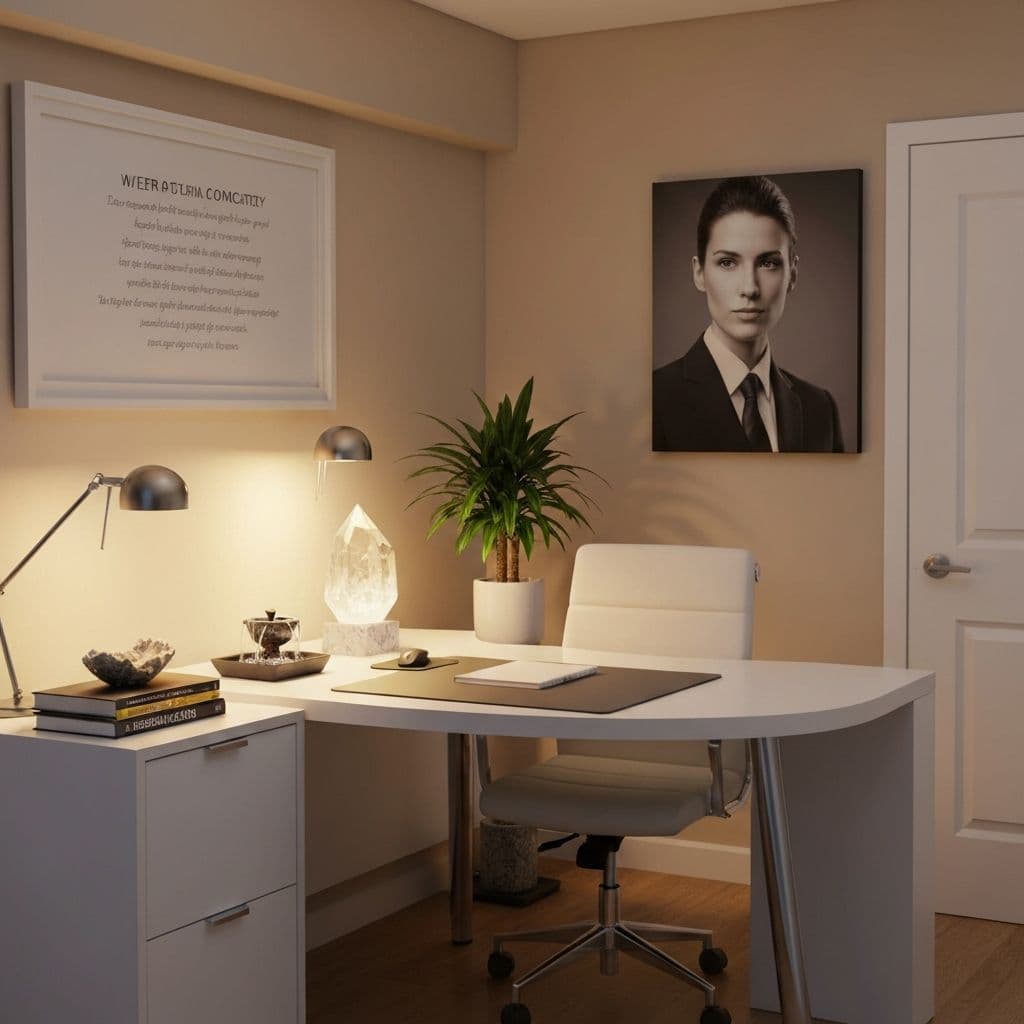


A Feng Shui L-shaped desk is a two-wing work surface. You sit on the command leg so you see who enters. You park files and a printer on the return. The chair does not jam into the inner corner, facing two walls, with its back to the door.
When we photograph work corners, the L is often shoved into a plaster elbow. The chair faces two tops as walls. The latch is a surprise. People ask which crystal belongs on the return. We ask them to sit on each wing and find the door. The desk position page is generic command for any table: latch in view, off the center line, something solid behind you. Extra screens are the second monitor article. Elbow height and a floor pad are the standing desk page. This page is the two wings: which one you sit on, and which one holds the printer.
Which leg of the L should you sit on?
Sit on the wing that lets you see the office door. That wing is the command leg. The other wing is the return, even if it is the longer piece of wood.
Length does not pick the seat. A short return that faces the latch is still the place to type. A long run that stares into a closet is still the place for files.
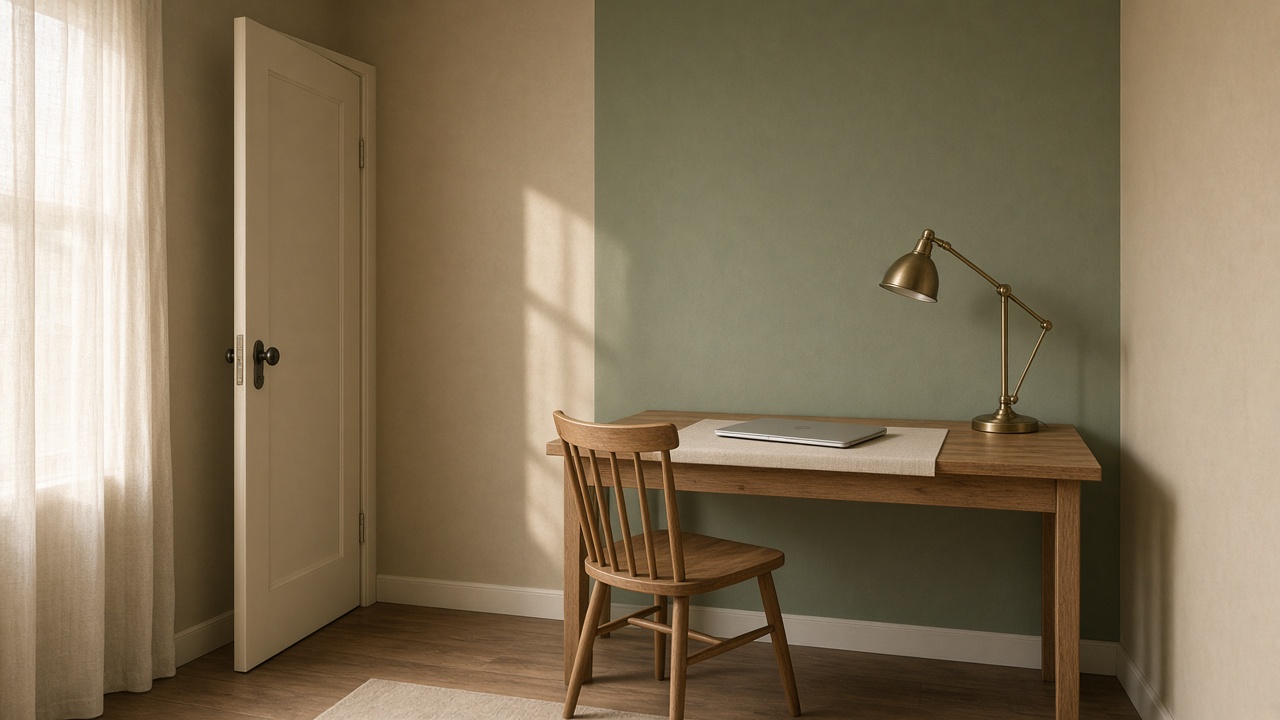
Stand at the threshold you use for the office, even if that is a bedroom door or a living-room arch. Then sit. You should see who enters without rotating your whole torso. You should not be the first object on a straight line from the jamb. A wall, a bookcase, or a high chair back should sit behind you. A window as the only back is glare and a draft. Pull off the glass a foot if the aisle allows.
A glance at the opening is the pass. A seat aimed square at the door, parked in the threshold, is the busy line. Angle the whole L if the room allows. If the rectangle only allows face-on, pull the footprint back from the jamb.
Do this at the hour you work, with the lights you use.

That chair is on the command leg. The door is in the glance. If your L looks like a cave in a corner, this is the photo to copy, not a catalog shot of a chair buried in the elbow.
How we check a real L desk
We stand at the office door. We sit on the long leg, then on the short leg. We look for the latch from each seat. We note whether the chair is in the inner corner, facing two walls. We walk the aisle and ask whether a guest clips the return. We do not assign a gua color to either wing.
If the only L that fits is a bedroom office, we still pick a command leg, then we shut the lid at night. A glowing return in a sleep room is a night-light you did not want.
Why does the corner jam fail?
The usual miss is the chair pushed into the inner corner of the L, knees under both tops, face to two walls, spine to the room. You cannot see who enters. You also cannot stand up without hitting a wing. That is a cubicle you built for yourself.
An L that uses a room corner as a mountain behind the chair can still pass. The test is the seat versus the latch, not whether the furniture touches two walls. If your back has plaster and your eyes have the door, the corner is a backstop. If your back has the door and your eyes have plaster, the corner is a trap.
Pull the chair out of the elbow. Sit on one straight run. Leave the inner corner as a gap you can stand into. A plant in that gap is fine if you water it and it is not in the knee line. Dead leaves on the return are a skip.

That jam is the fail. Two walls in the face, door behind the chair. Slide the seat onto one leg. Leave the elbow empty enough to stand.
If the L cannot turn, a small stable mirror that shows the latch is the substitute. Weight it. A shard balanced on the return will fall on the keys. Use the mirror after you try a rotate.
Where should the return, printer, and files go?
The return is storage and a landing, not a second command seat unless a second person also sees the door from that wing.
Printer: on the return, off the typing surface, with space to open the tray. A printer beside the keyboard steals the command wing.
Files: closed boxes or a low drawer under the return. Open piles become a wall in your side glance. Last year's paper is clutter. It is not a career gua.
CPU tower: under the return if your knees still fit. Do not park it in the only aisle.
Cables: clip under the lip. Do not staple a landlord baseboard. Loops at shin height are a trip.
| Object | Command leg | Return |
|---|---|---|
| Keyboard and the work you do now | Yes | No |
| Printer and paper tray | No | Yes, off the walk |
| Closed files | A thin stack at most | Yes |
| Chair | The seat that sees the latch | Only if that wing also sees the door |
A second person on the return needs their own latch view. If they face a wall, they have the corner-jam job on a smaller chair. Share the command wing on a schedule, or split the L into two straight desks. Do not sell the return as a lucky second seat.
No fountain on either wing. Water and power strips are a spill. A plant is fine if you water it and it is not dumping soil on the tray.
Do not draw a mini-bagua on the blotter and put "career" on the return's far-left. This L is two pieces of furniture.
Window light belongs at the side of the command leg when you can. A return that mirrors a west pane will glare into the command seat. Blinds help.
How is this different from a straight desk, a standing desk, and two screens?
A straight desk has one face. Command is the chair versus the door. An L adds a second face that can help or ruin that test. The extra wood is useful when it holds the printer off the typing wing. It is a fail when it builds two walls around the chair.
The desk-position guide already ranked layouts by the door. Use that page if your table is a rectangle. Come here when the top is two rectangles joined.
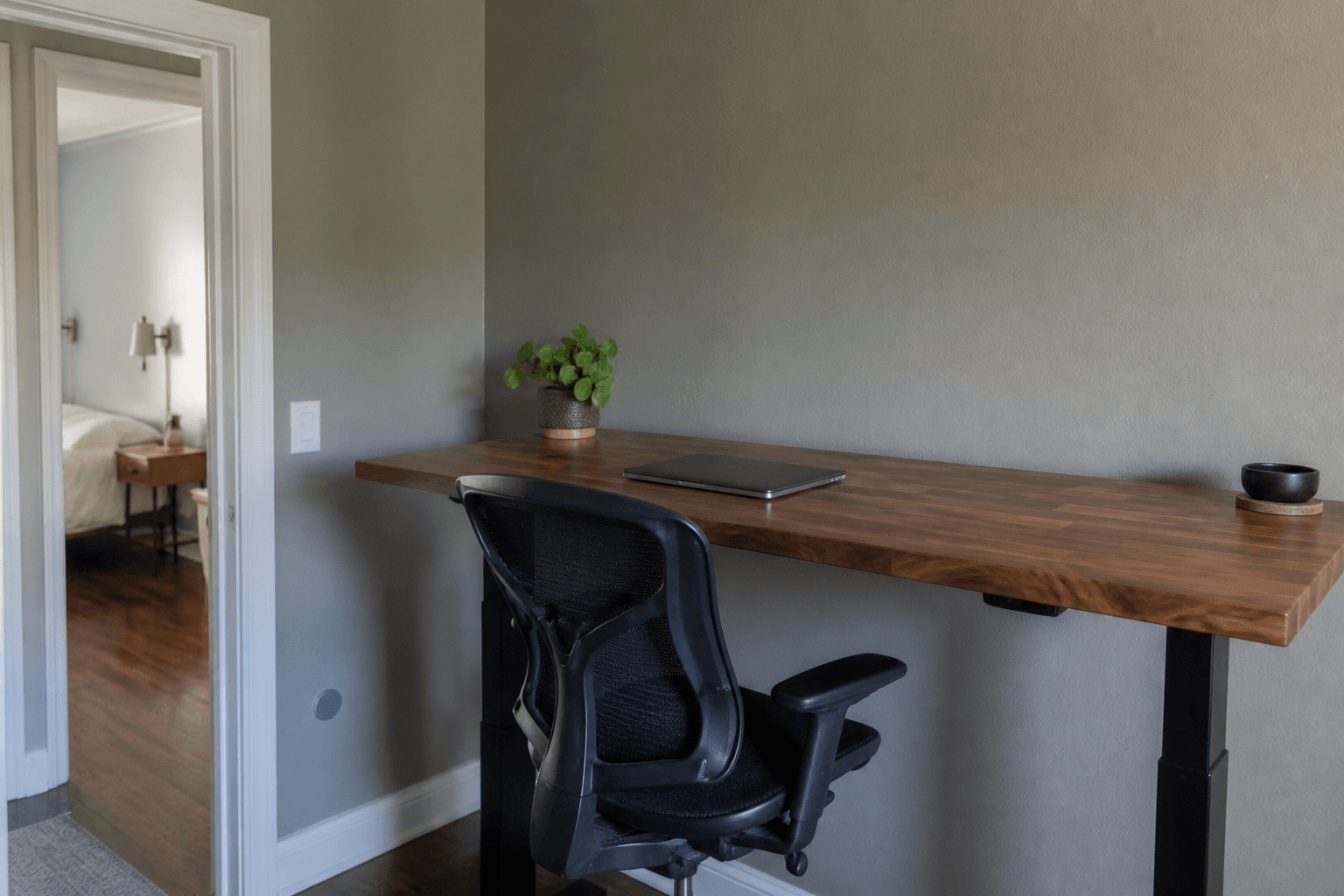
A standing desk is height and a floor pad. Command still matches sitting. Raise after the L already sees the door. A converter on a jammed corner L inherits the jam. An L that stands on one wing and sits on the other is two desks. Both have to pass the latch.
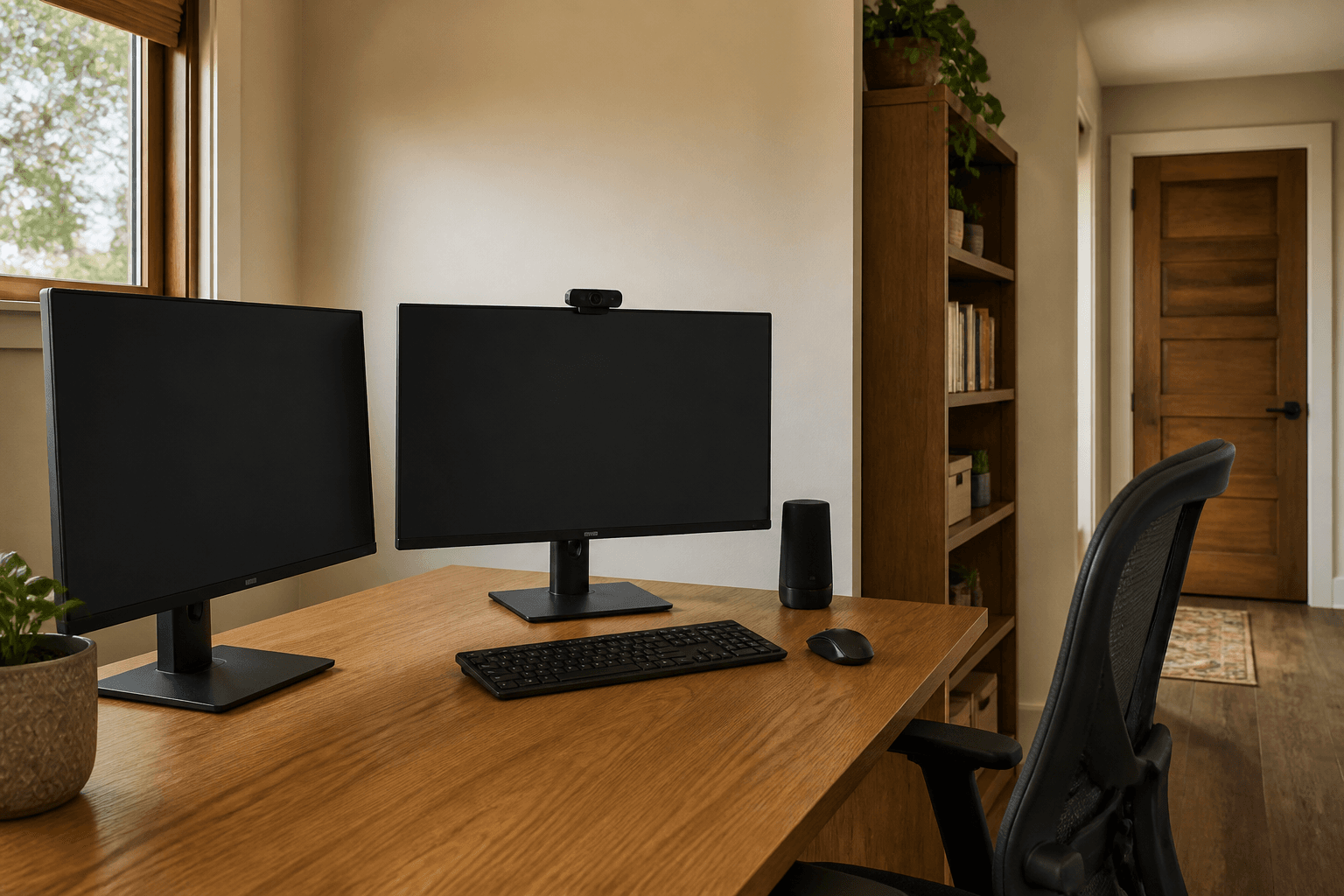
Two monitors split attention and catch glare. They do not pick which wing you sit on. Center the primary on the command body. Do not put the second screen on the return so you twist into the wall all day. If the pair is so wide that the door falls off your vision, slide the footprint or drop a screen.
A ceiling beam over the worker is a different office article. A closet office is a different footprint. Photograph the opening you actually use. The L still cannot eat the only walk to the kettle. The camera on a video call is not the latch.
Can renters use a modular L and split it at move-out?
Yes. Two tables that bolt, clamp, or sit with a connecting plate are the rental version. Felt pads under the feet save a vinyl deposit. Split the L when you leave. Take both tops. Fill the screw holes only if the lease asks and you made them. Prefer clamps.
A one-piece welded L is heavier to rotate. If you already own one, still do the sit test. Felt still goes under the feet. Do not screw that frame into a landlord floor.
If the return blocks the only walk from door to kitchen, the L is too big. Split it. Use one rectangle as the desk. Store the second top, or use it as a console off the mouth of the room. Layout cannot invent a spare office you do not have.
A folding return that only unfolds into plaster is the same fail in a thinner package. Unfold it to the command angle, or leave it folded and work from one straight run.
Shared studios: the office door may be the front door. The return still cannot live in the only walk from the latch to the sink. Bedroom offices: shut the lids at night. A glowing printer on the return is a night-light you did not want.
A listing "office nook" that jams the chair in a corner fails the guest walk. Hosts can leave the command leg free and the return empty enough to pass. A shop till versus the entrance is a different office article. Fire-code aisles still win.
Renter steps you can reverse tonight
- Stand at the office door. Sit on the long leg, then on the short leg. Write which seat sees the latch without twisting your whole spine.
- Move the chair onto that command leg. Pull it out of the inner corner so you can stand without hitting both wings.
- Put the printer, paper, and closed files on the other wing. Clear the typing surface except current work and a lamp you use.
- Clip cables under the lip. Get loops off shin height.
- If you face two walls, rotate the whole L, or split a modular L into one straight desk that sees the door.
- Add felt under the feet. Do not screw the frame into the floor.
- If the footprint cannot turn, add a small stable mirror that shows the opening, then still sit on one leg, not in the elbow.
- Photograph the office from the door with the chair on the command leg.
If you cannot tell the command seat from a cave, the L failed. The door has to be a glance. The printer can live on the return without sitting in your lap.
A chair left in the aisle clips the walk. Tuck it under the command lip. If the only quiet floor is a hallway, you do not have an office L. You have a trip in the mouth of the room. Work at a table that already sees a door.
What this is not
It is not the sitting desk-position pillar. That article is the chair, the layouts ranked by the door, compass as optional. This page asks which wing of an L is the seat.
It is not the standing-desk article. Height, converter, and the floor pad live there. Raise after command is honest.
It is not the second-monitor article. Dual screens split attention and catch glare. One laptop or one screen lives on the command body here.
It is not a promotion spell. Facing north on the return will not mint a title. Form School wants the latch in view. Compass notes wait until the door is visible, and they are still optional.
It is not an L-shaped apartment guide. That page is two floor rectangles and a shared entrance. This page is a piece of furniture.
It is not a diagnosis. A health question belongs with a clinician. Do not put an aquarium on the printer wing.
What should you do tonight?
Sit on each wing. Keep the seat that sees the door. Move the printer onto the other wing. Pull the chair out of the inner corner. If you still face two walls, split a modular L or rotate the whole footprint.
Then photograph the office from the door. If the first object is a chair buried in an elbow, the L failed. The latch has to be a glance. The return can wait as storage.