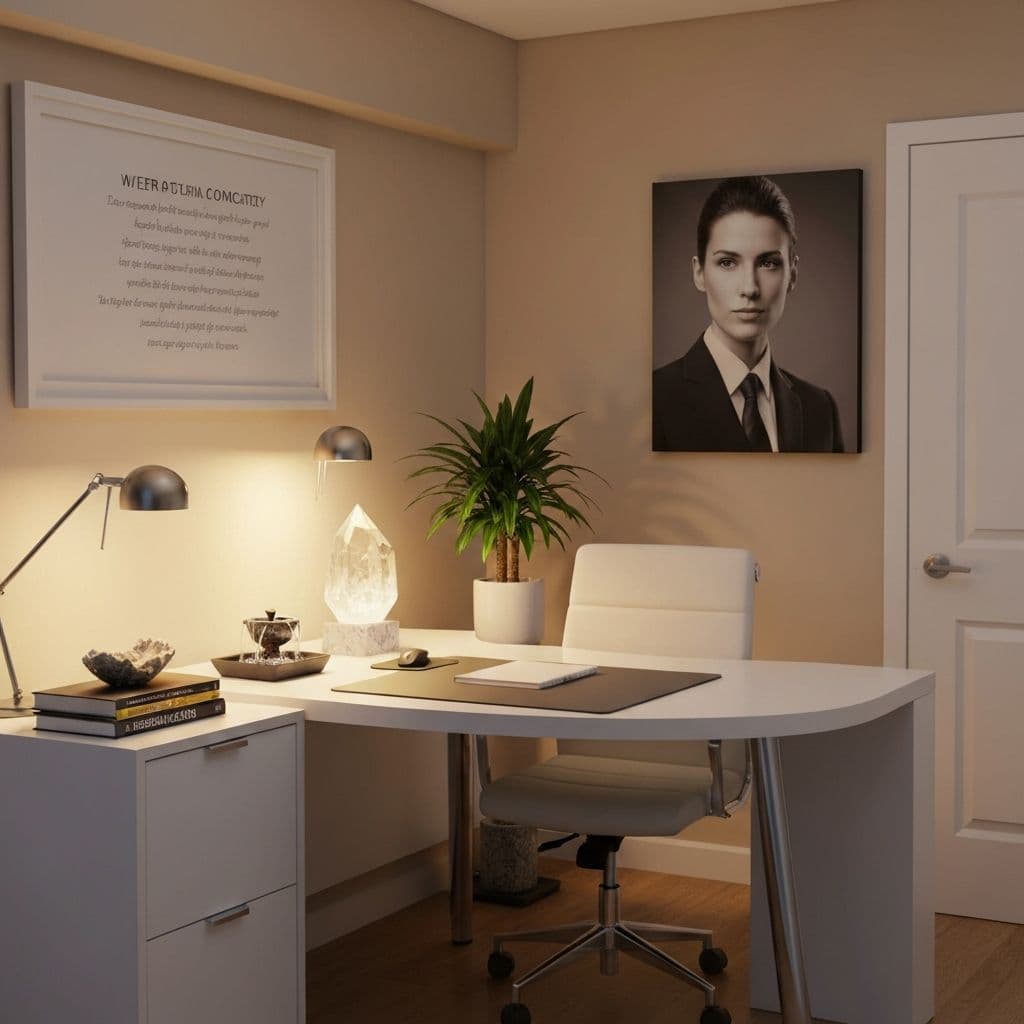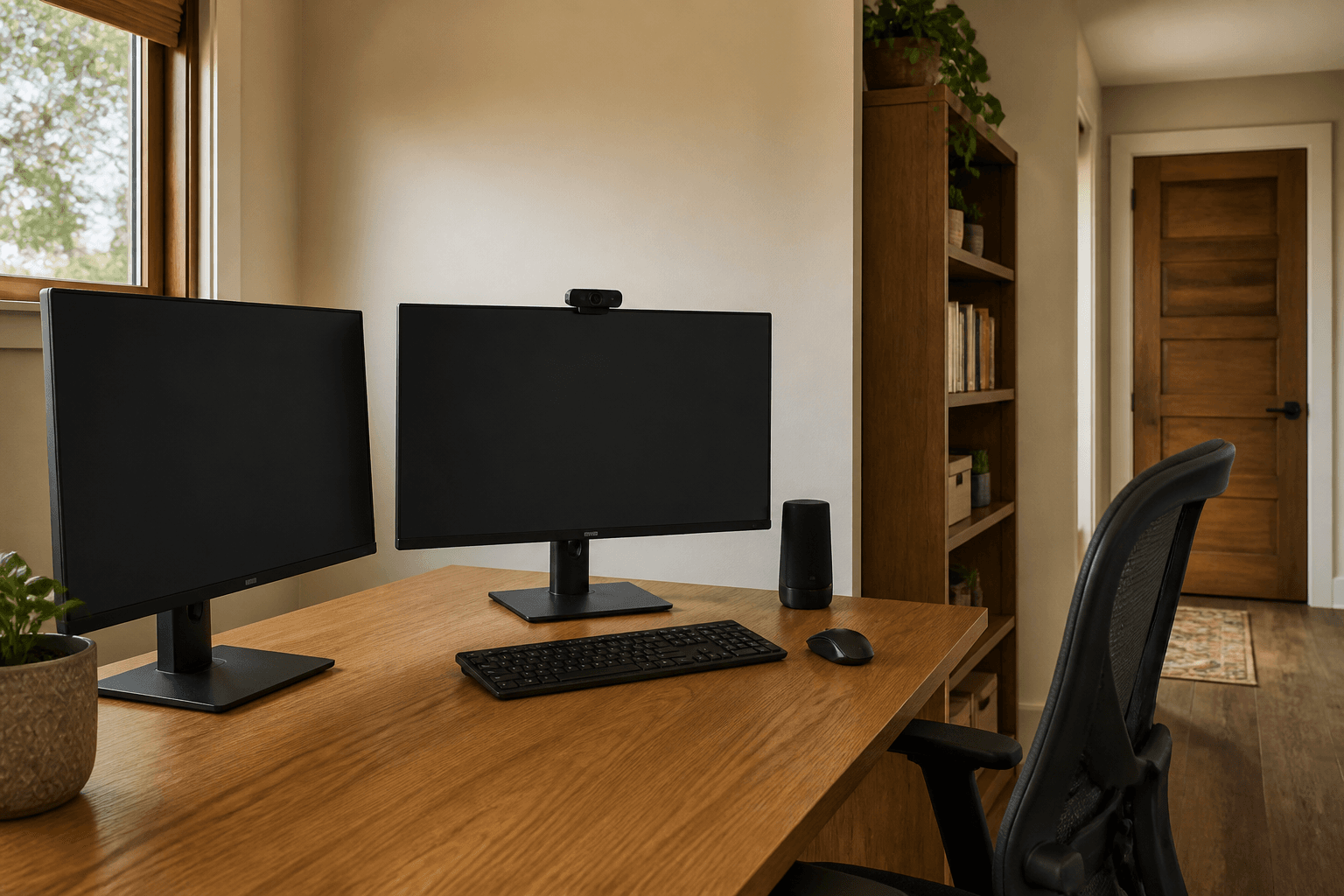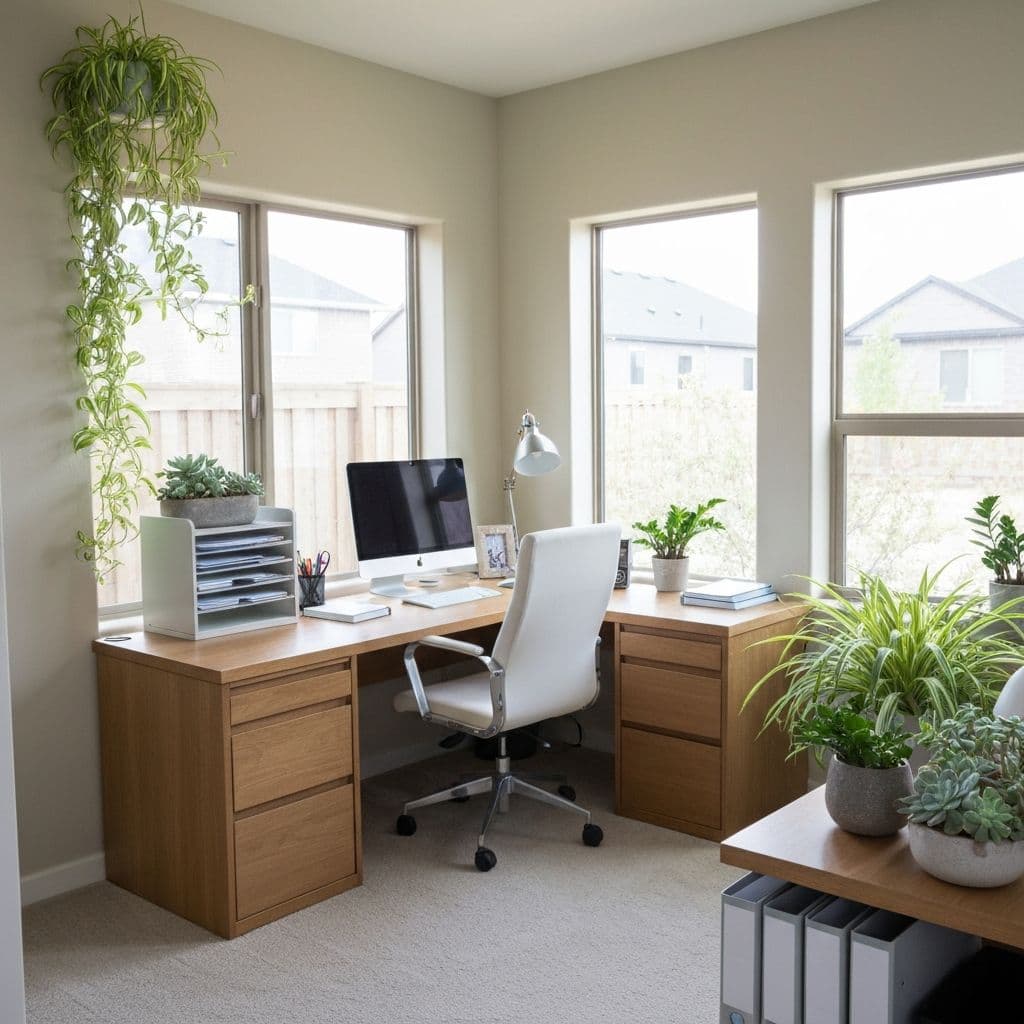

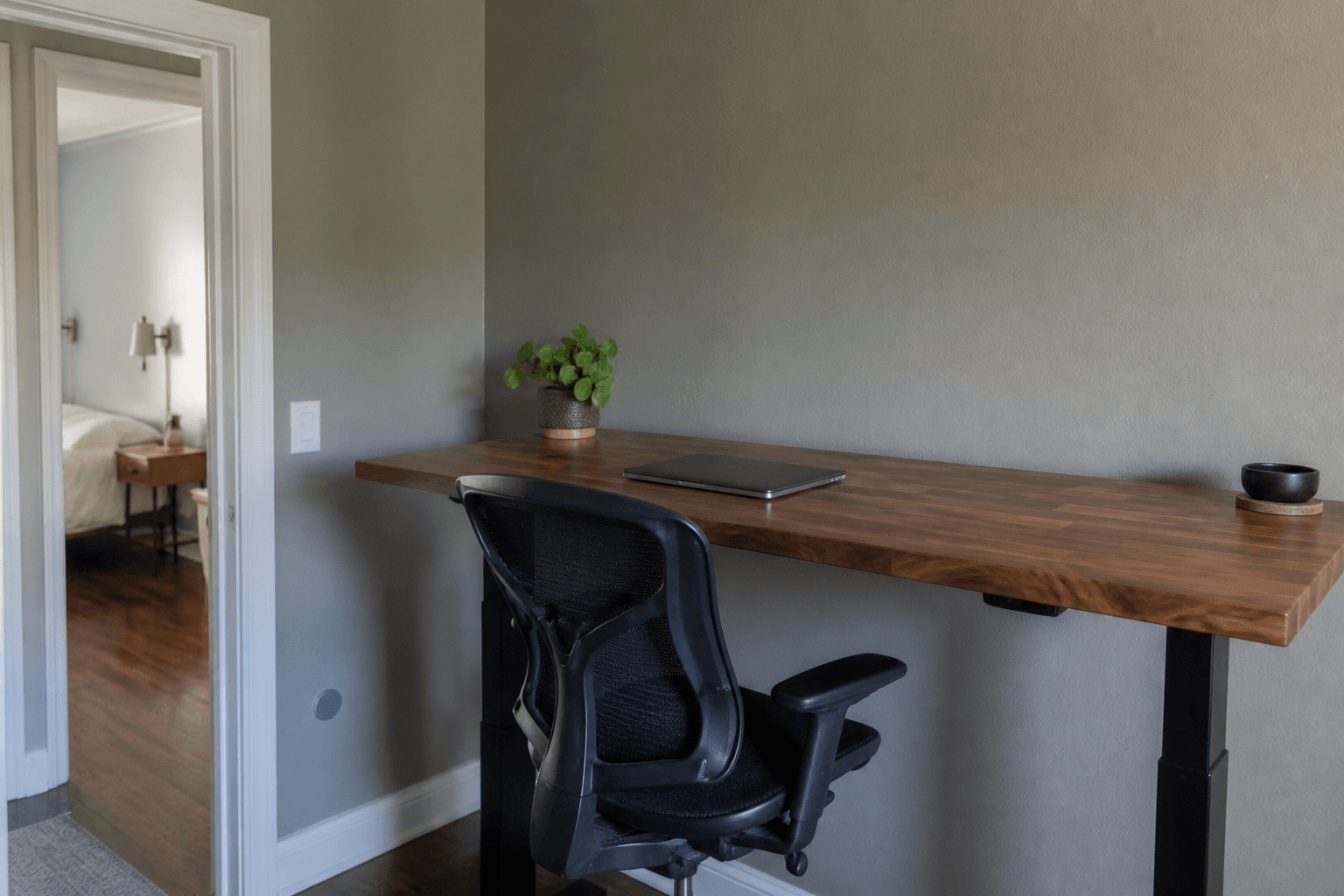
A Feng Shui standing desk is an elbow-height work surface that still lets you see who enters, keeps you off the door's center line, and has something solid behind you. Command is the same geometry as a sitting desk. Height is furniture, not a gua. A converter and a full desk both have to pass the door test.
When we photograph work-from-home corners, the new standing desk is often a converter jammed against a closet wall, laptop lid up, chair dumped in the only aisle. People ask which crystal belongs on the riser. We ask them to stand where they type and find the latch. If the door is a surprise, the raise did not fix the desk.
The sitting chair test lives on the desk position page. Extra screens are the second monitor article. The wider room, plants, and colors are the home office guide. This page is the standing surface in a home office: elbow height, converter or full desk, and a floor mat that is a zone instead of a trip.
Should a standing desk still see the door?
Stand at the office door. Then stand where you type.
Command at a standing desk is the same geometry as sitting. You can see who enters without twisting your whole torso. You are not the first object on a straight line from the jamb. A wall, a bookcase, or a high chair back is behind you even when the chair is tucked. Raising the top does not change the latch.
Do this at the hour you work, with the lights you use.
- Stand in the doorway you use for the office, even if that is a bedroom door or a living-room arch.
- Stand on the spot your feet occupy when you type. Look for the latch. If you have to rotate your whole torso, mark command.
- Check the center line. If you are the first object a guest hits, pull back or angle.
- Notice what is behind your spine: wall, bookcase, window, or closet doors.
- Walk the aisle. If your standing spot is in the kettle path, the desk is in the corridor.
Write which of those failed. The next sections only fix those.
A glance at the opening is the pass. A stance aimed square at the door, parked in the threshold, is the busy line. Angle if the room allows. If the rectangle only allows face-on, pull the footprint back from the jamb.
The higher eye line can clear a sofa back that ate the chair view. It can also stare into plaster because the laptop is now at face height against a wall. Neither result is a compass problem. A standing desk that faces north with the latch in your spine is still a back-to-the-door desk. The desk position page already says a north desk will not get you promoted.
If the table cannot turn, a small stable mirror that shows the latch is the substitute. Weight it. A shard balanced on a converter will fall on the keys.
The chair you tucked
When you stand, the chair is a second object. Tuck it under the desk so a roommate can enter. A chair left in the aisle clips the walk. Folding chairs that live three feet behind you are clutter in the mountain. Slide them off the spine line.
Bedroom offices: at night, lower the surface or shut the lid. A tall glowing slab in a sleep room is a night-light you did not want.
How high should a standing desk sit?
The top meets your elbow when your arms hang. The keyboard lives on that surface. If you use a converter, the keyboard deck is the height that matters, not the old dining table under it.
Bring a tape. Set the height. Rest your hands as if you were typing. If the keyboard sits well above or below the elbow, move the surface. Then look at the door. A lid that is now a wall in front of your face is too aggressive for this room, even if the elbow test passed.
Mark the column with painter's tape a renter can peel. Electric memory buttons are furniture presets, not luck. Use them so you return to the same height after someone else leans on the crank.
Too high, the screen becomes a fence and you lose the latch over the lid. Too low, you lean into a tall table that is still aimed at a closet. Do not chase millimetres from a blog. The tape is so tomorrow's you can find today's height. This is furniture. It is not a treatment and it is not a gua.
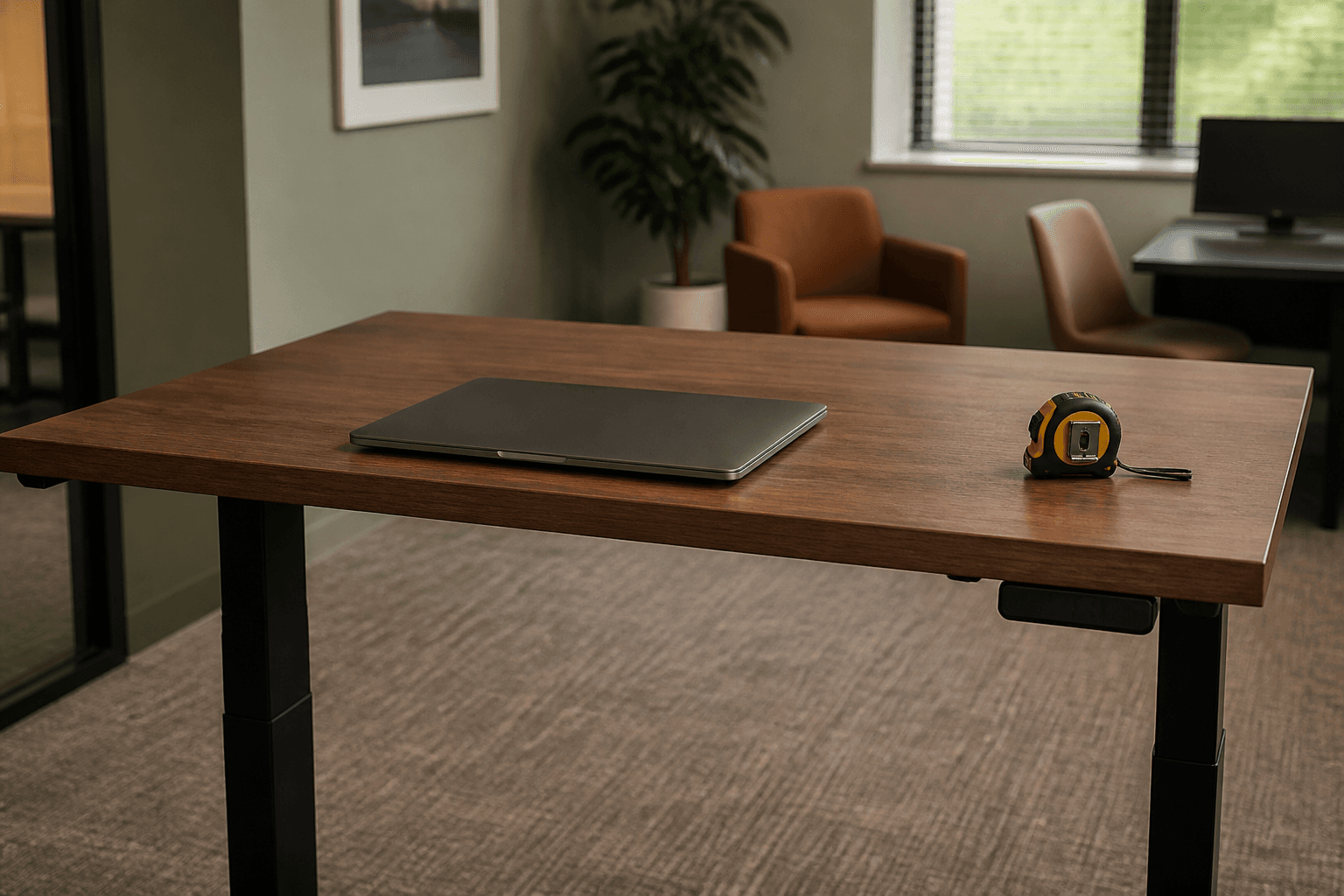
That tape on the top is the height check. You match the surface to the elbow, then you confirm the lid still leaves a gap to the door.
Sit height and stand height on one footprint
If the desk also sits, mark both heights. Command has to pass in both. A sit mode that faces the room and a stand mode that faces the wall is two desks, and one of them is a fail. Keep the same angle.
A laptop-only converter: tilt the screen so you see the jamb past the bezel. Closing the lid is for shutdown, not for the hour you type. Two screens belong on the other article.
Converter, full desk, or a wall you cannot see past?
A converter is a box on a table you already own. A full standing desk is a footprint you can turn as one piece. A wall you cannot see past is the fail both of them share when the work face is plaster, a closet, or a stack of riser plus lid plus a plant.
Turn the table before you raise. If the dining table already has its back to the door, the converter inherits that. Height will not invent a sightline. Rotate the table, or swap it for a desk you can angle, then put the converter on top. After dinner in a work-from-home living room, mark the table with tape where the box sits so command returns the next morning.
A full desk is the easier rotate. Watch the feet, the crank handle, and the power brick. An electric column in the walk is a shin. Leave a shoulder-width aisle. Renters: do not screw the frame into a landlord floor.
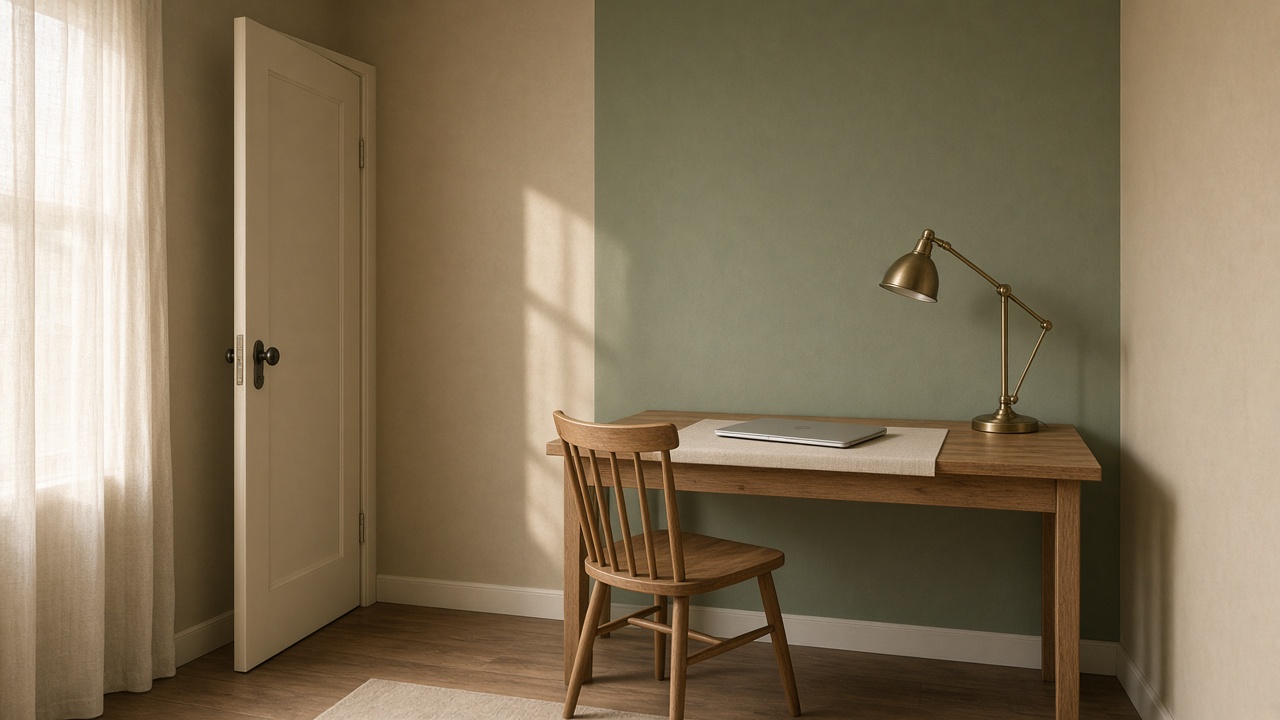
The wall fail is common in spare rooms. You work facing paint. Stand in that picture and the latch is in your back. Pull the desk out a foot if the aisle allows, or angle it so the opening is a glance. A folding desk that only unfolds into the plaster is the same fail in a thinner package. Unfold it to the command angle, or do not use it for the job.
| Setup | Helps | Fail |
|---|---|---|
| Converter on a table that already sees the door | You keep the table you have | Stack becomes a fence; table still faces plaster |
| Full desk you can rotate | One footprint turns | Legs, crank, or brick in the aisle |
| Face the wall and stand anyway | None for command | Latch in the spine, lid as a second wall |
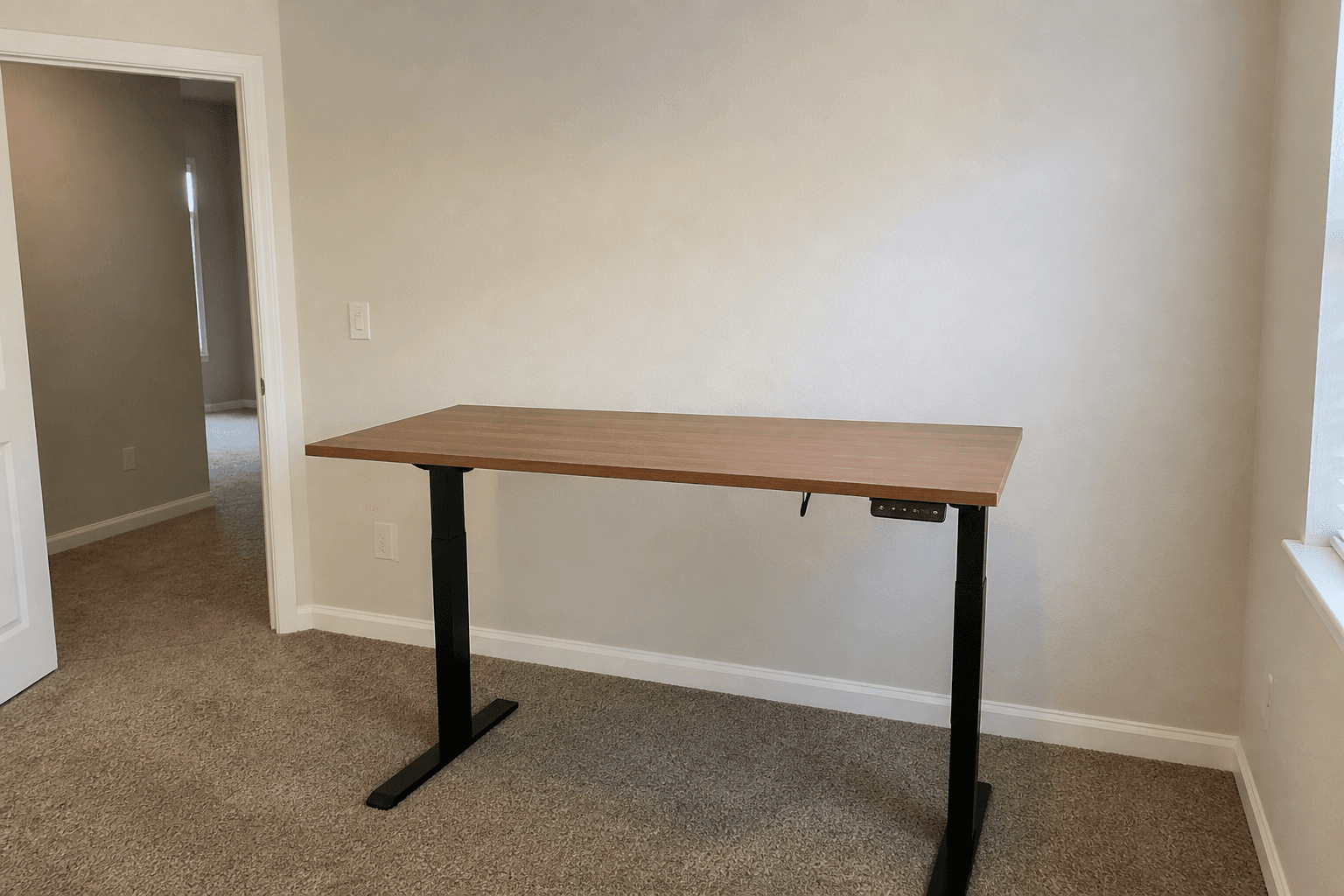
That blank wall is the fail. The door is behind the standing spot. Angle or pull out. Do not buy a taller converter for this picture.
Cables and a lid that is a wall
Loops at standing shin height are a trip. Velcro or a clip under the lip. Do not staple the landlord's baseboard. A crank that sticks into the aisle is a hip check. Park it in.
If you also use two screens, stop and read the second monitor page. This article will not place a satellite display.
A wobbling converter is a skip until you tighten it or change tables. A standing surface that rocks is a tray, not a desk. Soil on a keyboard is a mess. No fountain. Water and power strips are a spill.
Where should the anti-fatigue mat sit?
Shop names call it an anti-fatigue mat. On this page it is a floor pad that marks where you stand.
A defined zone helps. Your feet have a place. You are less likely to drift into the threshold or the roommate's path. Put it under the standing spot, square to the desk, inside the furniture line.
A trip is the same pad in the aisle, on the door swing, or with a curling edge a guest will catch. If the only floor left for the mat is the walk to the kettle, the desk is in the corridor. Move the desk. Do not invent a lucky rectangle on leftover carpet.
Keep it off the latch side if that is how people enter. A mat that holds the door open is a wedge, and a wedge is not command.
Do not print a bagua on it. Do not assign the front-left corner of the foam to career. The home office article can argue colors on walls. The mat is a trip test.
Bedroom path: roll the mat at night if it sits between the bed and the bathroom. Shared studios: the office door may be the front door. Photograph that opening. The mat still cannot live in the only walk from the latch to the sink.
How do you set this up in a rental tonight?
Do this in order. Stop when the latch is in view, the top meets your elbow, and the floor pad is a zone. All of it reverses: tape, angle, mat, mirror. No masonry. No floor screws.
- Stand at the office door, then stand where you type. Write whether you see the latch without twisting your whole torso.
- Set the surface to elbow height. Mark the column with tape you can peel. If the desk also sits, mark that height too.
- Tuck the chair under the desk. Clear the aisle so a guest can pass.
- If you face plaster, rotate the table or the full desk. Add a small stable mirror that shows the opening only if the footprint is frozen.
- Place the mat under your feet, out of the aisle and off the door swing. Flatten the edge.
- Clip the cables under the lip. Take the shrine off the riser if it is stealing the keyboard.
- Stand at the door again. The standing spot should not be the first object in the lane.
If the converter still faces a closet after a rotate, the table is the wrong table. Swap the furniture, or accept the mirror as a substitute.
What this page is not
This page is not the sitting desk position pillar. That article is the chair, the layouts ranked by the door, compass as optional. This page asks whether a standing surface still has the latch.
This page is not the second monitor article. Dual screens split attention and catch glare. One laptop or one screen lives here.
This page is not a medical article. It will not treat your back, name a diagnosis, or sell a height as a cure. Elbow height is where the furniture meets your arms. A health question belongs with a clinician, not a bagua.
This page is not a promotion spell. Facing north while you stand will not mint a title. Form School wants the latch in view. Compass notes wait until the door is visible, and they are still optional.
A ceiling beam over the worker is a different desk article. Do not hang folklore on the converter to lift career. Do not put an aquarium on the riser.
If you only do one thing tonight, photograph from the office door in FengShui Hero. Then stand at the desk and compare the flagged opening with the latch you can see. Height, converter, and the mat wait until that picture is honest.